Timekettle M3 vs WT2 Edge: Budget or Hands-Free?
By Mark Fulton ·
Last verified:
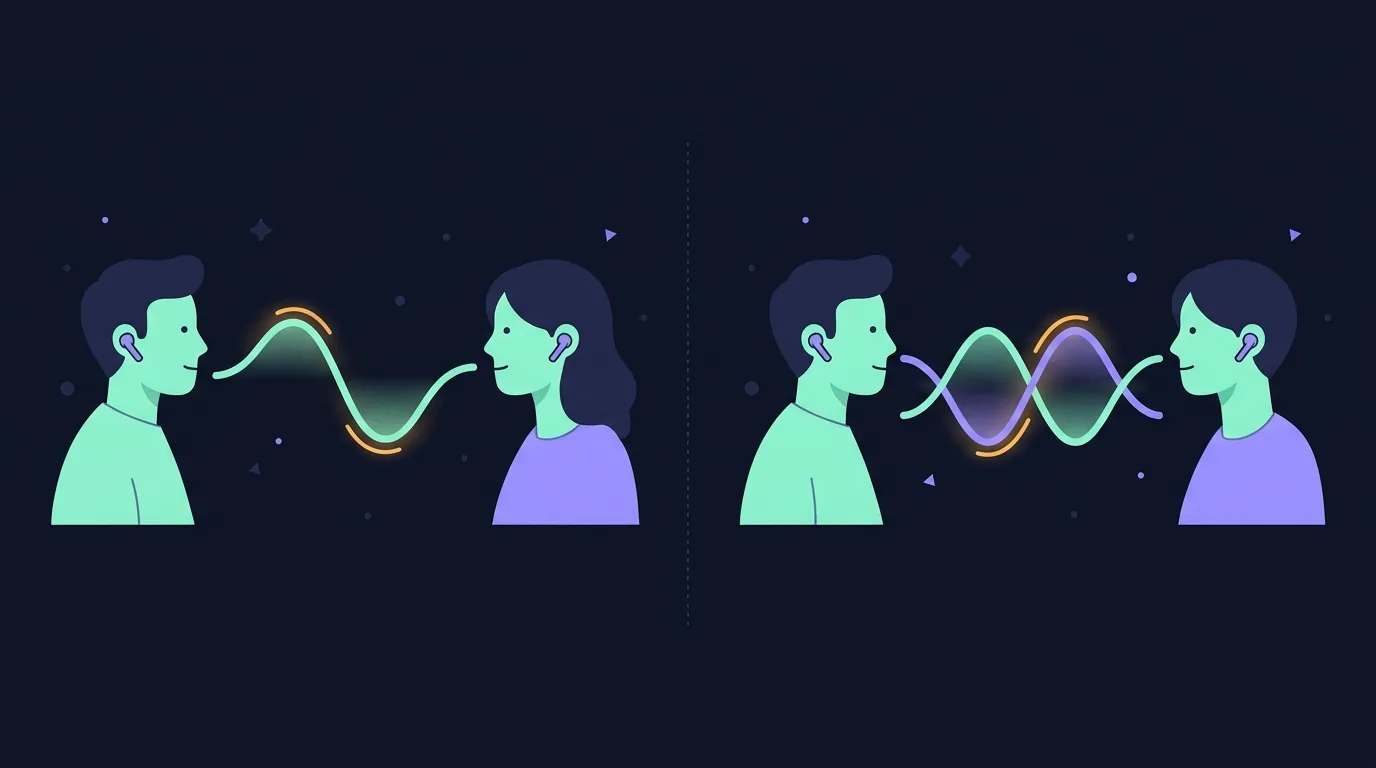
Choose the M3 if you want one pair of earbuds that also plays music and takes calls, and your translated conversations are short and one person at a time. Choose the WT2 Edge only if you will hold long conversations where both people talk freely without tapping, or run small group conversations. On 27 October 2026 Timekettle's store listed the M3 at $89.99 (down from $149.99) and the WT2 Edge at $279.99 (down from $349.99), a gap of $190.00 on sale prices. The WT2 Edge is translation-only by Timekettle's own spec table, and it lists 3 hours of translation per charge against 7.5 hours for the M3. If your plans are a trip or two a year, your phone's free translation features may be enough and you can skip both.
I sell a competing kit, so here is how this page works. Every Timekettle fact below was read from Timekettle's own M3 and WT2 Edge store pages on 27 October 2026, or from the independent reviews named in the text. I have not tested either product, so I make no claims about how well they perform in your hands. Where owners complain, I quote only what I read, and I say where it was read.
What is each model designed for?
The two products were launched a year apart. Timekettle's WT2 Edge page lists 2021 as the time to market and the M3 as 2022. They were built for different jobs.
The WT2 Edge (also sold as the W3) is a translation-only pair. Timekettle's comparison table marks it as the model with simultaneous two-way interpretation, hands-free controls and a 6-person capacity, and marks music playback and phone calling as not supported. Timekettle's own recommendation is "deep and long communications with friends or business partners."
The M3 is the budget pair that doubles as everyday earbuds. Timekettle describes it as translation, music and calls in one device, with active noise cancellation and an in-ear fit. Its recommended use is "short conversations abroad and entertainment functions." Timekettle's table marks its translation controls as "touch required" and its simultaneous two-way interpretation as not supported.
Here is the spec sheet side by side, as Timekettle lists it:
| M3 | WT2 Edge | |
|---|---|---|
| Sale price (27 Oct 2026) | $89.99 | $279.99 |
| List price | $149.99 | $349.99 |
| Translation controls | Touch required | Hands-free |
| Simultaneous two-way | No | Yes |
| People in one conversation | 2 | Up to 6 (3 pairs) |
| Music and phone calls | Yes | No |
| Active noise cancellation | Yes | No (voice noise cancellation for the mics) |
| Translation per charge | 7.5 hours | 3 hours |
| With charging case | 25 hours | 12 hours |
| Fit | In-ear | Half in-ear |
| Languages | 43 (96 accents) | 43 (96 accents) |
| Offline | 13 pairs listed | 13 pairs listed |
The battery lines are Timekettle's own lab figures, and its page notes that real life varies. Both products need the Timekettle app on a phone to translate, per each product's FAQ.
How do the prices compare today?
On the sale prices above, the WT2 Edge costs about 3.1 times the M3. The list-price gap is $200.00. Timekettle prices move often, so treat these as a snapshot from 27 October 2026.
Two oddities worth knowing. First, both models are sold in two variants, and the cheaper tab is not the simpler one. On the M3 page the "Online and Offline Translation" version was $89.99 and the "Online Translation" version was $119.99. The WT2 Edge page shows the same pattern, $279.99 against $299.99. Read the variant name before you add to cart.
Second, Timekettle's own comparison article on these two products still shows an M3 price of $119.99 and a WT2 Edge price of $299.99. It was published in April 2024, and the live product pages no longer agree with it. If you land on that article from a search, check the product page before trusting a number.
If you are weighing this pair against Timekettle's newer lineup, our W4 vs M3 comparison and W4 vs WT2 Edge comparison cover those choices, and the Timekettle price guide tracks the whole range.
Which one suits a 60-second conversation?
The practical difference is who has to do what. Here is the same one-minute exchange drawn through each product's published modes. Say you are a traveler and the other person is a local, you speak English, they speak Spanish, and you talk for about a minute about a rental booking.
| Moment in the minute | M3 (Touch mode, one earbud each) | WT2 Edge (simultaneous mode, one earbud each) |
|---|---|---|
| 0 to 10 s: you ask your question | You tap your earbud, speak, finish. The local hears the translation in theirs. | You speak. No tap. The local hears the translation as you go. |
| 10 to 25 s: they answer | They tap their earbud, speak, finish. You hear the translation. | They answer. If they start before you finish, both streams are handled. |
| 25 to 40 s: you interrupt to correct a date | You wait for them to finish, tap, then correct. | You speak over them, as people do. |
| 40 to 60 s: back and forth | Each turn needs a tap, so it runs like a walkie-talkie. | Turns overlap and the flow resembles a normal chat. |
| Who wears what | One pair shared: an earbud each. | One pair shared: an earbud each. |
| Who presses what | Both people tap, every turn. | Nobody taps. |
This is drawn from what Timekettle publishes about each mode, plus the independent testers who used both. MotorTrend, which tested both models, wrote that with the M3 "you need to speak one at a time" and each speaker touches the earbud when ready, while the WT2 Edge handles both people talking at the same time with no touching. The Barefoot Nomad's hands-on M3 review describes Touch mode the same way: each person wears an earbud and speaks by touching it lightly.
The tap sounds minor until the conversation is long. A single exchange costs you a second of fiddling. Twenty exchanges is a habit you have to teach the other person, and they have to agree to wear the earbud in the first place. Which brings up the second situation.
Which one suits sharing with a stranger?
Neither model wants you to share an earbud with someone you just met, and both have an answer. In Speaker mode you wear one earbud and hold your phone toward the other person, who talks to the phone. Timekettle's M3 page describes it as for ordering food or asking for directions with "no need to share your earbuds." The WT2 Edge page makes the same case for strangers: it ships two pairs of interchangeable tips and describes Speaker mode as designed for short, random bilingual conversations.
So for a stranger, the two are roughly even, and you are paying for neither product's headline feature. That is the main reason the M3 makes sense for most travelers. The WT2 Edge's advantage is realized in conversations with someone who is willing to wear an earbud for a while, such as a relative, a colleague or a client.
For larger groups, the WT2 Edge page describes a six-person meeting function in Touch mode that needs three pairs, with each person's earbud assigned a language in the app. Count the cost before you plan around that. Three pairs at the sale price is $839.97. Our business meetings guide looks at alternatives for that job.
Which one doubles as everyday earbuds?
The M3. Timekettle's table lists music playback and phone calling for it, and its FAQ confirms it works as ordinary Bluetooth earbuds as well as a translator. The WT2 Edge is listed as translation only. MotorTrend made the same point, saying the M3 can replace your existing earbuds every day, though it called the sound quality "merely fine."
That matters more than it sounds. If you buy translation hardware and it spends 11 months a year in a drawer, a pair of earbuds you wear for commutes and calls earns its place more often. The M3 also has the longer battery on paper, with a gap Timekettle states itself: 7.5 hours of translation against 3. If you travel for long days away from a charger, that difference counts.
One thing to expect on the WT2 Edge: with only 3 hours of translation per charge, a full day of meetings means using the case.
What do owners complain about?
Timekettle hosts review summaries on its own product pages, which makes them a sales page rather than an independent view, but they list the complaints too. On the M3 page, from 119 reviews, the summary says customers noted that earbuds can fall out, Bluetooth occasionally drops, offline translation needs work, and delay can reach 15 seconds for long sentences. It also reports a slight 2 to 3 second delay in general. On the WT2 Edge page, from 145 reviews, the summary lists translation delays, limited offline language options, and accuracy affected by background noise or rapid speech.
On Reddit I read one 2024 thread titled "TimeKettle, Dose it worth?" in r/LanguageTechnology, and it is a mixed bag. A commenter said the WT2 Edge battery "always dies quickly," even from a charging case. Two commenters said the M3 gave them no advantage over free Google Translate, one citing push-to-talk instead of an always-open microphone, and another reporting inaccurate translations and ambient-noise gibberish while travelling. Several replies posted on the same day in April 2026 were short and positive about the M3 in quiet one-to-one use, but I would weight them lightly. That is a handful of anonymous comments, not a survey.
MotorTrend's testers found something that applies to both: the delay grows the longer a person speaks, so a couple of short sentences work better than monologues, and speaking at a normal pace works better than speaking slowly.
The pattern across the sources is consistent. Both products do best in quiet, one-to-one talk with short sentences. Both disappoint in noise, with fast talkers, and with long monologues.
When should you pick neither?
Skip both if any of these is true:
- You need translation a few times a year. Google documents a live translate mode through your headphones on Android, and Apple documents translating messages, calls and conversations on iPhone. Both are free. They are clumsier than earbuds in a long chat, but they handle menus and directions.
- You are in loud places most of the time. Every source, including the vendor, says noise hurts. Our guide to translation earbuds in noisy places goes into it.
- You assumed offline would cover your language pair. The 13 offline pairs on the Timekettle product pages all involve English or Chinese. Check your pair, and read what offline mode loses first.
- You want a cheaper pair of hardware. Our cheap translation earbuds guide lists other budget options.
And if you are not sure how two-way translation works at all, how both sides actually hear explains the three things vendors mean by the phrase before you decide which one you need.
Before you choose a mode
Whichever pair you consider, the question underneath is whether the way you talk suits tap-to-speak or simultaneous talk. You can test that without buying anything. The free demo on the home page lets you say a sentence and hear it come back translated, in your browser. Try it with a friend and see how it feels to wait your turn.
For context on our own offer: we sell a $69 earbud kit and AI Translation Live, a browser speech-to-speech app, at $39 a year. It is a different shape from Timekettle's, with ordinary earbuds and the translating done in software. I make no performance claims about it here. The case is only that you should hear the sound of translated speech before you spend $90 or $280 on a mode you have not tried.
FAQ
Is the WT2 Edge better than the M3?
It is better at one thing and worse at several. On Timekettle's published specs, the WT2 Edge adds simultaneous two-way interpretation, hands-free controls and a 6-person capacity. The M3 adds music, phone calls, active noise cancellation, a longer listed battery and a price about a third as high. "Better" depends on whether you hold long, free-flowing conversations.
Can you listen to music on Timekettle translator earbuds?
On the M3, yes. Timekettle lists music playback and phone calling, and its FAQ says it works as ordinary Bluetooth earbuds. On the WT2 Edge, no: Timekettle's comparison table marks both as not supported.
Which Timekettle model works offline?
Both list the same thing on their product pages: 13 offline language pairs in the headline specs, downloaded to your phone in advance. Every pair named on the pages involves English or Chinese, and language support is limited in offline mode, so check your pair before you rely on it. Our guide on whether translation earbuds need Wi-Fi explains the limits.
Is the WT2 Edge still worth buying in 2026?
Only for a specific need. It dates from 2021 by Timekettle's own table, and its battery life is the shortest of the pair at 3 hours per charge. Timekettle's main menu now lists the W4 Pro, W4 Plus, W4 and M3 under earbuds, with the WT2 Edge reached through its own page. If you want hands-free talk, check the W4 first, which our W4 vs WT2 Edge comparison walks through. Buy the WT2 Edge mainly if the six-person group mode is the reason you are shopping.