Cheap Translation Earbuds: What $20 Really Buys
By Mark Fulton ·
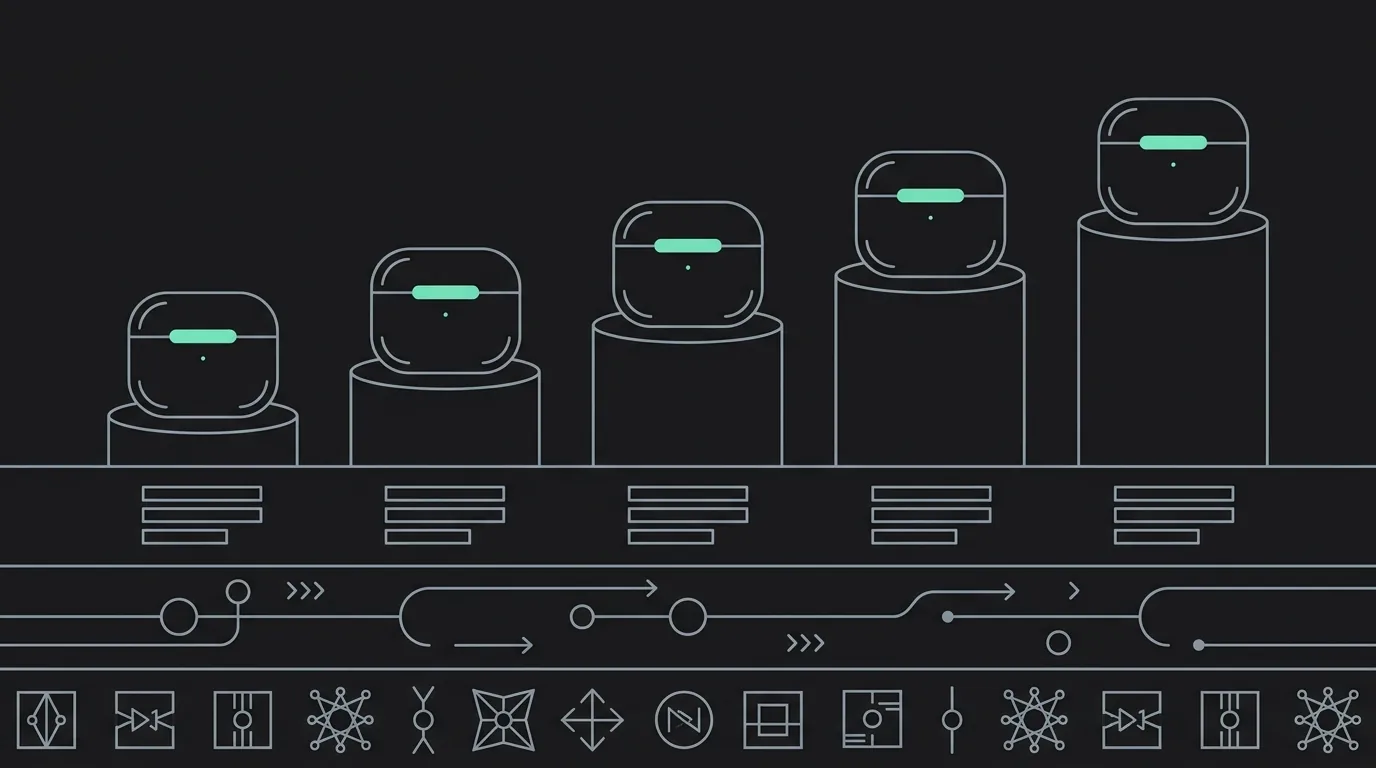
A $22 pair of translation earbuds is usually real hardware attached to somebody else's software, and the hardware is not the part that fails. At the bottom of this market the earbuds are a generic Bluetooth set that costs a seller under $25 landed, and the "translation" is a redemption code for a third-party phone app the seller neither wrote nor controls. That arrangement can work fine for a week in Lisbon. It falls over when the bundled app year ends, when the app's servers change, or when you need someone to answer an email about it, because the seller at that price has no margin to answer with. What you are actually buying as the price climbs is not better plastic. It is a better translation engine, a clearer statement of what running it costs, and somebody on the other end who is still there in month thirteen.
I sell translation earbuds at $69 with the software priced separately at $39 a year, which puts me near the affordable end of this ladder rather than the top of it. That gives me an obvious interest in you not buying the $22 pair. It also means I have no incentive to pretend the cheap tier is fake, the way the $400 brands do. It is not fake. It is just narrower than the listing suggests, and the gap between what it does and what it says is the whole subject of this post.
Why does the same-looking pair cost $22 and $99?
Because it is frequently the same pair.
A handful of contract manufacturers make a small number of true wireless earbud shells. Those shells get sold in bulk to anyone who wants them, with the buyer's name printed on the case and the buyer's app bundled in the box. You can watch this happen from the buying side, which I do: the same physical unit, same driver, same case, same LED charge readout, appears under a dozen brand names at a dozen prices.
The Bluetooth SIG's own rules make the re-badging visible if you know to look. Any company shipping a Bluetooth product has to run the Bluetooth qualification process under its own membership, and the SIG states plainly that a supplier cannot qualify a product on a reseller's behalf. So a dozen brands with a dozen listings for one physical design each hold their own paperwork on it. The design is shared. The brand is a label applied afterwards.
That is why price at the bottom of this category tells you almost nothing about the object. Two listings 4x apart can be the same object. The price difference is the seller's margin, the ad spend, and whatever software licence they attached.
What is identical across the budget tier?
Nearly everything you can hold.
- The radio. A commodity Bluetooth chipset with a rated range around 10 metres. Bluetooth version numbers get used as a selling point and almost never matter for translation, because you are streaming voice, not high-resolution music.
- The microphones. One or two MEMS mics per bud. Beamforming, where present, is basic. This is the part that actually limits translation quality and it is the part nobody prints on the box.
- The compute. None that matters. There is no translation model in a $22 earbud and there is none in a $449 one either. I wrote out the full signal path in how translation earbuds actually work, but the short version is that the buds are a microphone and a speaker on a wireless link, and every product in this category sends audio somewhere else to be understood.
- The language claim. The number on the listing comes from whichever translation API the bundled app calls, and it is usually a text-translation count rather than a speech count. The 144 languages claim traces exactly where that number comes from and why it inflates.
Because the hardware is common, hardware specs are a poor way to choose. Two pairs with matching spec sheets can behave completely differently, and the difference is upstream of the plastic.
What actually changes as you pay more?
Here is the ladder, split into the three things you are actually paying for. The tier prices are approximate market bands as of 2026-09-03, not fixed prices, and they move constantly with coupons and sales. Where a named product appears, I opened that company's own product page on 2026-09-03 and the price is what it showed me.
| Band | Hardware | Software | Support |
|---|---|---|---|
| ~$22 | Generic TWS shell, one or two mics, no meaningful noise handling | A redemption code for a third-party app the seller did not write. Often "free for one year", with no stated year-two price | Effectively none. At this margin there is nobody to staff it |
| ~$69 (ours) | Earbuds in the same hardware class, listed with confirmed specs only | Named engine, stated hours, stated renewal. Ours is AI Translation Live at $39/year with 5 hours of live translation included and 57 output languages | A named seller with a published renewal price and a working inbox |
| ~$99 | Better mics, better fit, sometimes an open-ear or clip design that is genuinely more comfortable | Usually a vendor-built app rather than a licensed one. Language handling improves. Watch for a bundled first year here too | Real, if the brand is a going concern. This is where a support page starts existing |
| ~$249 | Genuinely good consumer earbuds where translation is a feature, not the purpose. Apple lists the AirPods Pro 3 at $249.00 | Platform translation, tightly integrated, with a short and honest language list rather than a long and generous one | Retail-grade. Walk into a store |
| ~$389 to $449 | Purpose-built interpreter hardware, multi-mic arrays, hardware designed around two people talking. Timekettle lists the W4 Pro at $449.00 and Vasco lists the Translator E1 at $389 | Dedicated modes: simultaneous interpreting, meeting capture, call translation. Often offline packs for core pairs | Business-grade, with the price to match |
Read that table by column, not by row. Down the hardware column, the change from $22 to $99 is small and the change from $99 to $449 is real but is mostly about microphones and form factor. Down the software column, the change is enormous at every step. Down the support column, the change is binary: below a certain price there is no support, because the unit economics cannot carry a human being reading email.
That is the honest reason our kit is $69 and not $22. The earbuds are a commodity part costing a fraction of that. The rest pays for a translation engine that bills by the minute, a renewal price stated before you buy, and the fact that I answer. If you want the same hardware with none of that, it genuinely exists for about twenty dollars, and I would rather tell you than pretend the object is different.
What do marketplace ratings tell you at this price?
Less than you think, for a structural reason.
A star rating measures the experience a buyer had when they were motivated to leave a review, which is normally within a week or two of delivery. In that window a buyer can assess fit, sound, battery behaviour, whether the case arrived cracked, and whether a single tourist phrase came out roughly right. All of that is the earbud.
What a rating cannot measure is the part that breaks: the app, twelve months later. The bundled "premium membership" expiring, the third-party service going quiet, the OEM's app dropping off the store. Those failures land long after the review is written and long after the return window closed, so they are structurally underrepresented in the score.
I am not quoting star ratings for individual listings here. I only print a number I have read on the listing myself, and the advice does not need one. Read the one and two star reviews and sort by recent rather than helpful, and specifically look for reviews written by people who have owned the product for more than a year. If there are none, the product is younger than its first renewal cycle and its most important failure mode has not happened yet.
What's the failure mode of the cheapest option?
Not the earbuds dying. The software going away.
The cheap tier's translation lives in an app the seller licensed. Three things can end it, and none of them are your fault:
- The bundled year runs out. Listings advertise a "1-year premium membership" with a stated dollar value and then say nothing about year two. That silence is the single most common disclosure gap in this category, and I put real numbers against it in what translation earbud subscriptions actually cost. Live speech translation is metered by the minute in every cloud that offers it, so a free year is somebody absorbing a running cost, and running costs do not absorb themselves forever.
- The app changes or disappears. You have no relationship with the company that wrote it. Your relationship is with a marketplace seller who bought a batch of codes.
- Nobody answers. This is the one people underestimate. Your protections are still real: the FTC's Mail, Internet, or Telephone Order Merchandise Rule requires a seller who promised no ship date to have a reasonable basis for shipping within 30 days and to seek your consent for delays beyond it, and the FTC's guidance on warranties notes the law requires any warranty to be available for you to read before you buy, in person or online. Both are worth knowing. Neither of them makes a translation app come back.
When the software goes, you are left with working generic earbuds. That is not a disaster at $22. It is a bad outcome at $99, and it is the reason to check the renewal terms before the box, not after.
What should you refuse to pay extra for?
Four things, in order of how often they carry a premium they have not earned.
A bigger language number. 100, 144 and 164 all describe the API behind the app, not the device, and they mix text languages with spoken ones. Our own page says 57 output languages because that is what the engine we use actually speaks, counted from the engine itself. A larger number on a cheaper product is not a better product.
An accuracy percentage. Vendors publish figures like 90-something percent accuracy with no test set, no language pair, and no noise condition attached. A percentage without a method is a design element, not a measurement.
Noise-cancellation claims stated as percentages. Noise handling matters enormously for translation, more than almost anything else on the spec sheet, which is exactly why it attracts made-up numbers. Judge it by microphone count and array design, or by trying the thing, not by a figure.
"AI" in the product name. It costs nothing to add and it appears at every tier including the bottom one.
Things worth paying for, by contrast: more and better-placed microphones, a stated renewal price, offline packs if you actually travel without data, and a seller who is still going to exist next year.
If you want to hear where the software sits before you spend anything, the live demo on our homepage runs the same engine our kit ships with, in your browser, with nothing to install. Then compare the total against whatever listing you were looking at, including its year two. Ours is $69 for the kit and $39 a year for the software, priced separately and stated on the page. Any listing worth buying should be able to tell you the same two numbers.
Frequently asked questions
Are cheap translation earbuds a scam?
Usually not, but they are frequently mis-sold. You receive real earbuds that really connect to a real translation service, so nothing fraudulent has occurred. What is misleading is the framing: the listing describes intelligence living in the hardware when the hardware is a microphone and a speaker, and it advertises a language count belonging to a service the seller licenses rather than owns. The commonest genuine complaint from buyers is that they thought they were buying a device and discovered they had bought a code for someone else's app.
Why are some translation earbuds so cheap?
Because the physical product is a commodity. A generic true wireless shell can land in a seller's hands for well under $25 including shipping, and translation adds no hardware cost at all since the translating happens in the cloud. Anything above that landed cost is margin, advertising, software licensing and support. Sellers who plan to provide none of the last two can price very close to the landed cost and still make money.
Is $20 translation hardware safe to buy?
Physically, a generic Bluetooth earbud from a marketplace is a low-risk purchase, and the usual sensible precautions apply: pay by card so you keep your right to dispute a charge for something that never arrives or arrives wrong, and read the return window before ordering, not after. The real exposure is not physical. It is that you are installing a phone app from a company you have never heard of and granting it microphone access, so it is worth reading what that app says it does with your audio. I went through the questions to ask in translation earbuds and privacy.
What's the minimum I should spend?
If you need translation for one trip and you will never use it again, the cheap tier is a defensible purchase and free phone apps are a defensible alternative, which I compared in translation earbuds vs a phone app. If you expect to use it past the first year, the minimum useful spend is whatever the cheapest product is that states its year-two price in writing before you buy. That threshold is a disclosure test rather than a dollar amount, and it is the single filter that removes most of the bad outcomes in this category. For a wider comparison of what sits above the budget tier, see the best translation earbuds.