Translation Earbuds in Noisy Places: What Breaks
By Mark Fulton · August 26, 2026
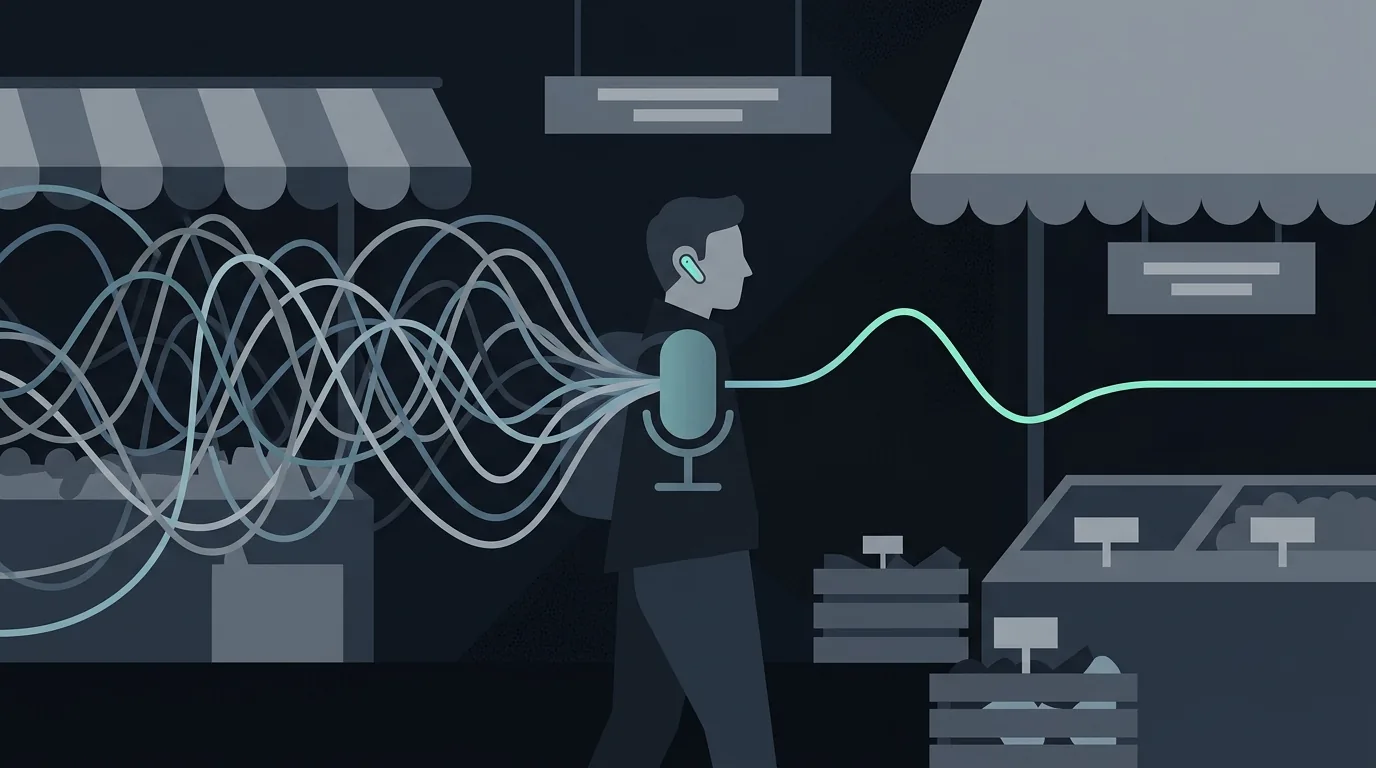
Translation earbuds work in a noisy restaurant, but not as well as they work anywhere quiet, and the way they fail is worth understanding before you rely on them. Noise almost never damages the translation step. It damages the step before it. If speech recognition mishears "we can't eat that" as "we can eat that", the translation model does its job perfectly on the wrong sentence and hands you fluent, confident nonsense with no warning attached. That is the whole risk in this category: noise does not produce garbled output that you can spot, it produces clean output that is wrong. What improves your odds in a loud room is mostly how close the microphone sits to the talker, how you take turns, and where you sit. It is only slightly about which earbuds you bought.
I sell a translation earbud kit and a browser translation app, so the honest version of this article is also the useful one. I would rather you know exactly which rooms this technology handles and which ones defeat it than buy from me and find out at a market stall in a language you do not speak.
Why does background noise break translation and not just audio?
Every speech-to-speech translation product runs the same chain of jobs, whether it splits them into separate services or fuses them into one model: capture the audio, decide when a phrase has ended, recognise the words, translate them, speak them back. I broke that chain down stage by stage in how translation earbuds actually work, and the important property of a chain is that an error at the front never gets repaired at the back.
Machine translation is very good at turning a sentence in one language into a sentence in another. It has no way to tell that the sentence it received is not the sentence you said. There is no confidence signal passed forward that says "the recogniser was guessing here". So the failure mode of a noisy room is not a broken translation. It is a fluent translation of a misheard phrase, delivered in the same calm synthetic voice as everything else.
Noise also attacks a second stage that gets almost no attention: the decision about when you stopped talking. Most systems use silence as the cue. In a room where the noise floor never drops, there is no silence to find, so the system either commits too early, cutting your sentence in half, or waits and waits while the translation lags further behind the conversation. On a train platform with a rolling public address announcement, I have watched systems simply never commit at all.
Two things follow from that. First, any accuracy number you see quoted for a translation product is a recognition number in disguise, measured in whatever room the tester was standing in. Second, the mitigations that actually work are the ones that improve the audio arriving at the microphone, not the ones that improve the model.
What is a microphone actually fighting in a crowded room?
Three separate problems, and they need different responses.
Energetic masking. Noise that physically overlaps your voice in frequency and time, drowning parts of the signal so there is nothing left to recover. Research on the cocktail party problem distinguishes this from a second effect: work by Bee and Micheyl on how listeners solve the cocktail party problem separates energetic masking from informational masking, where competing speech interferes even when it does not overlap the target in frequency or time. Traffic, machinery and ventilation cause the first kind.
Competing speech. Other people talking is the hardest case, because a recogniser trained on human speech will happily transcribe the wrong human. This is where machine listening is still clearly behind human listening. The CHiME-6 challenge on multi-speaker recognition in real home recordings exists specifically because distant, unsegmented, overlapping conversational speech remains an unsolved research problem, not a settled engineering one. Your earbuds are running a consumer version of the same task.
Distance and geometry. Sound pressure falls off steeply with distance, so a talker two metres away arrives far weaker than one at arm's length while the room noise stays exactly as loud. Reverberation compounds it. In a hard-surfaced room, the reflected copies of a word arrive late enough to smear into the next word, blurring precisely the consonants that carry meaning.
For scale, the NIDCD puts normal conversation at 60 to 70 dBA, and notes that sustained exposure at or above 85 dBA risks hearing damage. OSHA offers a field test worth memorising: their occupational noise exposure guidance says that if you have to shout to be understood at arm's length, the level might be over 85 decibels. If you are shouting at arm's length, you are roughly 20 decibels above conversation level, and no consumer microphone array is going to dig your voice back out of that.
Which noise types are worst?
Here is the failure log. Six settings, the mechanism in each, the specific way it breaks, and what actually helps. I have ordered them roughly from workable to hopeless.
| Setting | Acoustic mechanism | How it breaks | What helps |
|---|---|---|---|
| Taxi | Engine and road rumble, low frequency, plus wind if a window is open. Bad geometry: the driver faces forward, one metre away, speaking off-axis past a headrest. | Vowels survive, consonants get buried under the rumble. Numbers and street names degrade first, which is exactly the content you needed. Wind noise on an open window produces long stretches the recogniser drops entirely. | Close the windows before you speak. Hand the phone or the earbud forward rather than shouting from the back seat. For an address, show the written text instead of speaking it, and ask the driver to stop before any exchange that matters. |
| Restaurant | Reverberation off hard floors, glass and bare tables, plus a steady bed of competing conversation from neighbouring tables. | Reverb smears the end of each word into the start of the next, so plosives and sibilants blur. Output stays grammatical and confidently wrong. Short phrases fail more often than long ones because there is less context to recover from. | Ask for a booth or a banquette. Soft seating, curtains and carpet cut reverberation more than anything you can buy. Sit in a corner rather than mid-room, avoid the table under the speaker, and keep the capturing microphone on the table between you rather than near the aisle. |
| Street market | Broadband traffic noise plus close-range competing speech from vendors, often louder than your talker and often calling out set phrases. | The recogniser latches onto the nearest strong voice, which may not be the person you are talking to. You get a fluent translation of a stranger's sales pitch. | Step out of the aisle into a doorway or a gap between stalls. Keep the talker within arm's length. Turn your body so the crowd is behind the microphone rather than in front of it. |
| Train platform | Low-frequency rumble from rolling stock, impulsive brake squeal, and a public address system producing intelligible speech at high level. | Two failures at once. The rumble masks vowel energy, and the PA is speech, so the system tries to transcribe the announcement. Worse, the noise floor never drops, so the end-of-phrase detector never fires and the translation stalls. | Wait for a train to clear before speaking. Move away from the platform edge and away from the PA horn. Keep each turn to one short sentence so a stall costs you seconds, not a whole exchange. |
| Bar | The densest competing speech of any everyday setting, plus amplified music with vocals, plus the Lombard effect: everyone raises their voice, which distorts their own articulation. | Multiple talkers within a metre, all at similar levels, with sung vocals adding speech-like content the model cannot categorise as noise. Recognition becomes close to a coin toss on anything longer than a few words. | Step outside or into the entrance corridor for anything that matters. Inside, expect to type. This is the setting where I would not claim my own kit works. |
| Building site | Broadband machinery noise across the whole speech band, plus impulsive noise: hammers, reversing alarms, compressors cycling. | Broadband noise leaves no clean frequency region to recover speech from, so there is nothing for filtering to isolate. Impulsive noise resets the recogniser mid-phrase. Apply the OSHA shout test here and you will usually fail it. | Move behind a barrier, into a site cabin, or into a vehicle. There is no earbud answer to this room. Type, or use written safety-critical instructions, and treat any spoken translation as unverified. |
Two patterns run through all six. Competing speech is worse than loud noise, because a recogniser cannot tell that a voice is the wrong voice. And distance costs you more than volume does, because halving the gap to the talker improves the signal without touching the noise at all.
What can you change about how you speak?
More than you would expect, and it costs nothing.
- One sentence per turn. Short turns give the end-of-phrase detector a clear job and limit the damage when a turn fails. Long paragraphs fail wholesale.
- Slow slightly, do not raise your voice. Shouting flattens your pitch contour and clips consonants, which makes recognition worse rather than better. Speaking a little slower and articulating word endings makes it better.
- Pause before and after, not in the middle. A clear half second of your own quiet at each end of the phrase helps segmentation. A pause mid-sentence gets read as the end.
- Front-load the load-bearing words. If the sentence carries a number, a time or a place name, put it early rather than trailing it at the end where a premature cut-off will remove it.
- Read numbers back. Prices, times, platform numbers and dosages are the most frequent casualties. Repeat them, or show them written.
- Say it plainly. Idiom, sarcasm and half-finished sentences survive a quiet room and die in a loud one. This applies to the person you are talking to as well, and it is fair to ask.
I would rather give you those six than a specification number. They move accuracy in a loud room further than any hardware difference between mid-range translator earbuds.
What can you change about where you stand?
Position is the highest-leverage variable available to you, and it is free.
Shorten the distance. Whatever is capturing the audio should be closer to the talker than to the noise. Inside arm's length is a reasonable target. Every doubling of distance costs you signal while the room noise stays constant.
Use the room's soft materials. Curtains, upholstery, coats, carpet and other people's bodies all absorb reflections. A corner banquette in a busy restaurant beats a centre table in a quieter one, because reverberation is often doing more damage than level.
Separate the noise from the talker in space. The cocktail party research describes spatial release from masking, with roughly 6 to 10 decibels of improvement in speech recognition when the interfering sound comes from a different direction than the target rather than the same one. Human listeners get that benefit from two ears, and it is a good reason to physically turn so that your talker and the loudest noise source are not on the same line. Put the crowd behind you and the talker in front.
Put a barrier between you and the source. A parked van, a wall, a doorway, a pillar. A few steps around a corner routinely does more than any setting in an app.
Do not confuse noise cancelling with clean capture. Active noise cancelling works on the playback side, making the translated audio easier for you to hear. It does nothing for the microphone picking up the other person. That distinction is the single most common misunderstanding in this category, and it is covered in more depth in do translation earbuds work.
When should you switch to typing instead?
Knowing when to stop is part of using this well. Switch to typed text when:
- The exchange is consequential. Medical information, allergies, legal or immigration matters, contracts, money, safety instructions. Text can be re-read, corrected and shown to a third person. Synthesised speech vanishes.
- You are failing the shout test. If you would have to raise your voice to be understood at arm's length, speech capture is already beyond its useful range.
- Two people are talking at once and neither will stop.
- The content is numeric. Times, prices, platform numbers, addresses and quantities are worth typing even in a quiet room.
- You have already repeated yourself twice. A third attempt in the same spot rarely works. Change position or change mode.
Typing is slower and it is not a failure of the product. It is the correct tool for a room that has defeated the microphone, and any vendor who tells you their earbuds never need it is selling you a demo condition.
Where our kit sits, plainly
The AIEarbuds kit is a $69 pair of Bluetooth 5.1 earbuds with a USB-C charging case, paired with AI Translation Live, our own browser speech-to-speech app, available as a $39 a year add-on with 5 hours of translation included. The earbuds handle capture and playback. Live does the translation, and it is the part I can actually stand behind, because I run it and can tell you what model it uses and what it costs me per minute.
What I will not tell you is that this kit beats noise. I have not measured it in a market or a bar, and until I have, any figure I gave you would be marketing. What I can tell you is that the physics above applies to every product in this category, at every price, including the $449 ones. Nobody has solved competing speech at two metres in a reverberant room, because that is still an open research problem.
So test it yourself, and test it in the wrong conditions on purpose. The live demo on the homepage runs translation in your browser with nothing to install and no hardware needed. Take it somewhere loud, before you rely on it somewhere that matters. Speak a sentence with a number in it, in a room like the one you are actually travelling into, and see what comes back. That is a more useful ninety seconds than any spec sheet, mine included, and it is why the demo sits at the top of the page instead of a claim.
If latency rather than noise is what you are weighing, what "real-time" translation actually means covers the delay budget in the same detail.
FAQ
Do translation earbuds work in a loud restaurant?
Usually yes, with a meaningful drop in reliability and a specific failure pattern. The problem is rarely translation quality. It is speech recognition mishearing words in reverberation and competing conversation, which produces a fluent translation of the wrong sentence rather than obvious gibberish. A corner booth with soft seating, one short sentence per turn, and the microphone within arm's length of whoever is speaking will get you most of the achievable improvement. Read numbers back before acting on them.
Does noise cancelling improve translation accuracy?
Not in the way most buyers expect. Active noise cancelling processes what you hear, so it makes the translated speech easier to follow in a loud room, which is genuinely useful. It does nothing for the microphone that is capturing the other person's voice, and that is where noise does the damage. Microphone-side processing exists too, usually beamforming and environmental noise cancellation, and it helps somewhat with steady broadband noise like traffic or engine rumble. It helps far less with other people talking, because the interference is speech and the system has no reliable way to know which voice you meant.
Why does translation fail when two people talk at once?
Because speech recognisers are built to transcribe one voice at a time, and overlapping conversational speech remains an active research problem rather than a solved one. When two talkers overlap, the system either transcribes the louder one, blends fragments of both into a plausible sentence, or fails to decide where the phrase ended and stalls. Human listeners handle this using two ears and a great deal of context. A pair of earbuds has far less to work with. The practical fix is turn-taking discipline: agree that one person speaks, pauses, and then the other replies.
What's the best way to use them on the street?
Get out of the traffic lane and out of the crowd flow. A doorway, a gap between stalls, or the lee side of a parked vehicle changes the acoustics more than any setting will. Turn so the noise is behind the microphone and your talker is in front of it, keep the gap inside arm's length, and speak one short sentence at a time. If wind is hitting the microphone, shield it with your body. For an address or a price, show the written text rather than speaking it, since those are the first things to break and the ones that cost you when they do.