Translation Earbuds in Thailand: What to Expect
By Mark Fulton · September 14, 2026
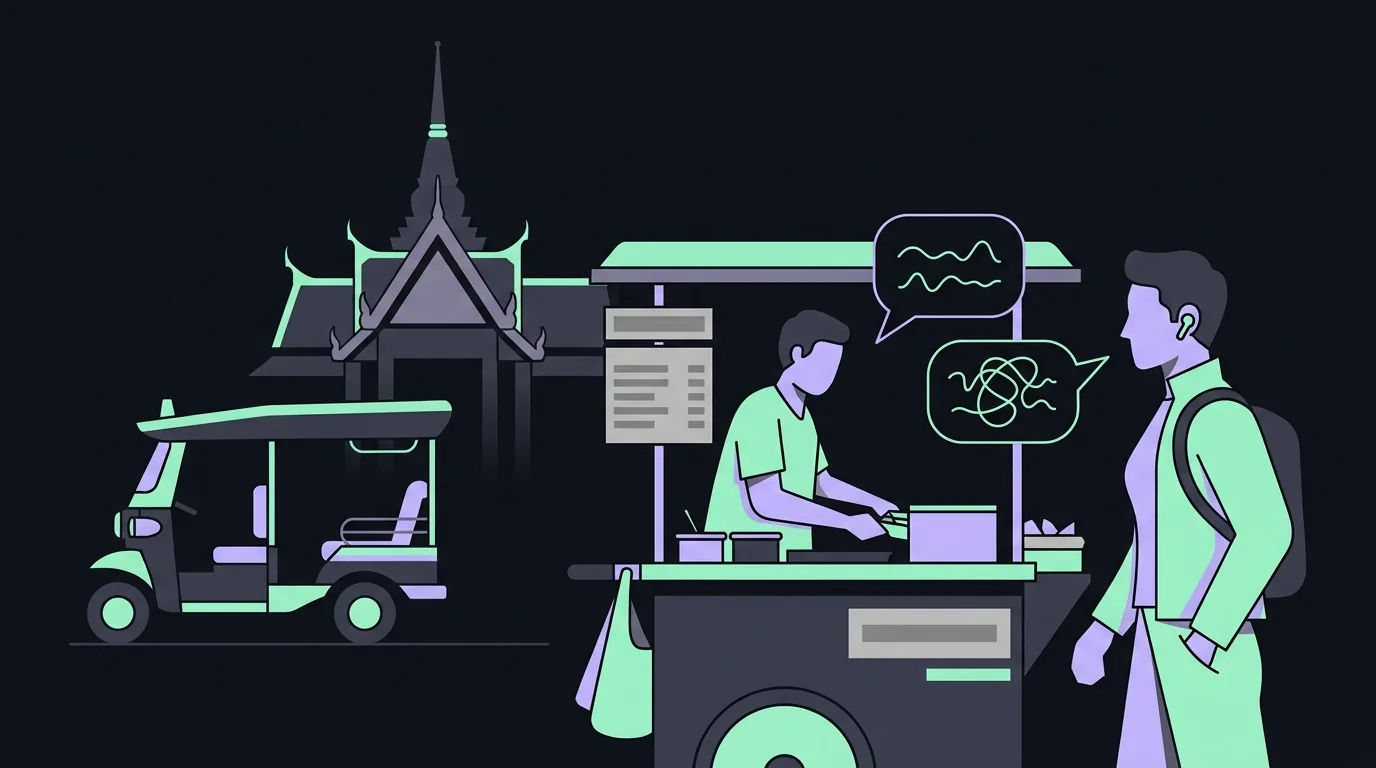
Translation earbuds do work in Thailand, but Thai is a harder language for them than Spanish, French or even Japanese, and you should plan the trip around that. Thai uses pitch to tell apart words that otherwise sound the same, its script runs words together without spaces, and the Thai you hear in Chiang Mai, Khon Kaen or a southern fishing town differs from the Bangkok standard these systems learn best. Expect short, clear, slow exchanges at a hotel desk or a quiet shop to go well. Expect fast street talk, noisy markets and rural dialect to go wrong more often. Carry a written fallback for anything involving medicine, money or officials.
I sell a translation earbud kit, and this is not the article a seller usually writes about Thailand. Most of what you will find is demo clips filmed in good conditions or product pages that list Thai as one more supported language. The honest discussion of how Thai actually behaves lives on expat forums, where long-term residents ask whether any device copes with Isaan dialect, whether anything translates Thai without a connection, and why the output sometimes means something nobody said. Those are the right questions. Here are the answers, with the reasons behind them.
Why is Thai harder for machine translation?
Three things stack up, and each one alone would make the job harder.
Thai is tonal. According to Britannica's entry on the Thai language, Thai uses tones to distinguish otherwise identical words, and it has five of them: mid, low, falling, high and rising. In English, raising your pitch at the end of a sentence turns it into a question but leaves the words unchanged. In Thai, the pitch is part of the word. Get it wrong and you have said a different word.
Thai text has no spaces between words. Spaces in written Thai mark the end of a clause or sentence, not the end of a word. Before a translation system can translate a Thai sentence, it has to decide where each word starts and stops, and that step introduces its own errors. Researchers at Chulalongkorn University describe word segmentation as a challenging first step for Thai language processing precisely because of the lack of explicit word boundaries, made harder by compound words built from smaller words.
There is less training data. Machine translation learns from large collections of sentences paired with their translations. Research on English to Thai neural machine translation describes Thai as a low-resource language, where data is often not available in the quantities needed to train a high-quality model, and notes that the missing word spaces add more complexity on top. English to Spanish has an ocean of paired text to learn from. English to Thai has a lake.
Regional Thai is not Bangkok Thai. Standard Thai is based largely on the dialect of Bangkok and the central region. Britannica notes that the Northeastern, Northern and Southern dialects differ in their tones and to some degree their consonants, and that the Northeastern dialects are similar to those of Laos. A system trained mostly on standard Thai is listening for Bangkok pitch patterns. A market vendor in Udon Thani may not be using them.
None of this means translation fails in Thailand. It means the margin for error is thinner, and the things that eat into that margin (noise, speed, slang, dialect) hurt more here than they do in Madrid.
What do tones do to speech recognition?
Speech translation happens in stages, even when a modern model blends them together. First the system has to hear which words were said. Then it has to translate them. Then it speaks the result. In a tonal language, the first stage depends on pitch far more than it does in English, and pitch is exactly the information that noise, distance and mumbling destroy first.
There is a clean experiment on this. A 2025 study from the University of Washington, Tone in Perspective: A Computational Typological Analysis of Tone Function in ASR, took speech recordings in three tonal languages (Thai, Vietnamese and Mandarin) and three non-tonal ones (Uzbek, Indonesian and Turkish), removed the pitch contours, and measured how much worse speech recognition got. The tonal languages degraded substantially more than the non-tonal ones. Of the six, Thai showed the largest jump in word errors and the largest increase in tone errors. The authors also found a consistent pattern in the mistakes: rising and falling tones tended to collapse toward level tones once the pitch information was gone.
Two cautions on reading that. The study removed pitch completely, which the authors call an extreme case, and it tested research models rather than any commercial translation product. So it does not tell you how any particular app or earbud performs. What it does tell you is where Thai is fragile. Anything that blurs pitch, such as a loud room, a speaker turned away from the microphone, fast casual speech that flattens tones, or a regional accent with different tone shapes, removes information Thai recognition leans on more heavily than recognition in most languages does.
The practical consequences for a traveller:
- Short words suffer most. Many Thai words are single syllables where the tone carries much of the meaning. A one-word answer is easier to mishear than a full sentence with context around it.
- Context rescues errors. A longer, complete sentence gives the model surrounding words to correct a misheard tone. Ask whole questions, and ask the other person to answer in a sentence if they can.
- Distance and noise hurt twice. Noise degrades every language. In Thai it specifically degrades the pitch cues that separate words. Get close, and get the phone or earbud microphone pointed at the speaker.
I went through the general version of the noise problem in translation earbuds in noisy places. Thailand is where that advice matters most.
Which travel situations still work well?
Plenty. The pattern is simple: calm, slow, one-to-one, and predictable vocabulary goes well. Noisy, fast, many voices, dialect or technical vocabulary goes badly. The table below is not a test log. It is what to expect in eight common Thailand situations, based on how tones, noise, dialect, script, speed and jargon interact with speech translation, with the fallback to reach for when it breaks.
| Situation | What tends to work | What is likely to go wrong, and why | Fallback |
|---|---|---|---|
| Street food stall | Asking whether a dish is spicy, pointing then asking a price, saying "no peanuts" as a full sentence | Traffic, sizzling woks and a queue behind you blur pitch, and vendors answer fast in one or two words, the hardest case for a tonal language | Point at the dish or the photo. Show allergies as a screenshot written in Thai. Hold up fingers or show digits on screen for quantity |
| Songthaew (shared pickup) | Telling the driver a destination before you get in, while the vehicle is stopped and quiet | Engine noise and wind in the back make live translation close to useless once moving. Place names are proper nouns that speech recognition often mangles | Show the destination written in Thai script on your phone before you board. Agree the fare by showing digits |
| Temple | Reading signs with the camera, asking a monk or attendant a simple, polite question in a quiet courtyard | Religious and Pali-derived vocabulary is specialist, and translated etiquette can come back flattened or oddly literal | Follow what others do. Read posted rules with the camera. Keep questions short and respectful |
| Clinic or pharmacy | Describing a single symptom in a calm consultation room, one sentence at a time | Medical terms are jargon, dosing instructions are exactly where a misheard tone or number changes meaning, and stress makes everyone speak faster | Show a written symptom list and your medication's generic name. Ask for dosing written down. For anything serious, ask for a human interpreter |
| Market haggling | A friendly opening line, asking the price, asking for a small discount | Numbers are easily misheard in noise, several vendors talk at once, and bargaining banter is fast and colloquial | Type prices as digits on a calculator screen and pass it back and forth. It is clearer and part of the game anyway |
| Immigration office | Understanding which queue or window you need, or which form to fill in | Legal and procedural vocabulary is jargon, officials may speak quickly, and a mistranslation here has real consequences | Bring documents and printed forms. Read written instructions with the camera. Use an official channel or a qualified person for anything that affects your visa |
| Hotel front desk | Check-in details, breakfast hours, laundry, directions to a nearby place. Often the best case: quiet, patient staff, predictable topics | Long, fast explanations covering several points at once. Staff switching between Thai and English mid-sentence can confuse the language detection | Ask one question per turn. Let staff finish before replying. Ask for key details, such as the wifi password or checkout time, in writing |
| Rural village | Greetings, simple thanks, one clear question to a younger person who speaks standard Thai | Regional dialect, including Northeastern varieties close to Lao, differs in tones and vocabulary from the Bangkok standard, and mobile signal can be weak | A few learned Thai phrases, pointing, a written note prepared in advance, and patience. Download an offline pack in case the signal drops |
Look at the shape of the fallback column. Almost every row falls back to something written or something shown: digits, script, a screenshot, a printed form. That is the single most useful habit for Thailand, and it costs nothing.
How does the written script change your approach?
For a lot of travellers the script matters more than the tones. Thai script is a syllabic alphabet with its own letters, vowel marks placed above, below, before and after consonants, and tone marks. Chulalongkorn's researchers count 44 consonant symbols, 15 vowel symbols and 4 tone symbols. You are not going to sound out a sign by guessing, the way you might in Italy.
That shifts the balance of tools:
- Your camera does the reading. Signs, menus, bus boards and packaging are printed text, and camera translation handles clean print well. Handwritten menus and stylised shop signs are harder, because the character recognition has to work before translation even starts.
- Show, don't say, place names. Thai place names are proper nouns that both recognition and pronunciation get wrong. Keep your hotel name and address saved as text in Thai script, and show it.
- Romanisation is a trap. The same Thai word can be spelled several ways in English letters, and romanised street names often do not match what a driver would recognise when spoken. The Thai script version is the one that works.
- Type instead of speak when the room is loud. Typed text skips the speech recognition step entirely, and with it all the tone problems. If a market is too noisy for voice, type a sentence and show the translation.
Before you fly, follow Google's instructions for downloading languages to use offline and confirm Thai appears in the list on your device. Then test camera translation in aeroplane mode at home. Offline packs are for reading and short text. Live speech translation, including ours, is a different requirement: it runs against a cloud model and needs a connection. The trade-offs are covered in do translation earbuds need wifi.
What about Vietnamese, Khmer and Lao?
If your trip covers more of the region, each neighbour brings its own version of the problem.
Vietnamese is also tonal. Britannica lists tones as a defining characteristic of the language, and the University of Washington study above counts six. In that study Vietnamese also degraded noticeably when pitch was removed, though less than Thai. Expect the same guidance to apply: short turns, whole sentences, quiet spaces, written fallback for numbers. Vietnamese is one of the output languages AI Translation Live supports.
Lao is the official language of Laos and, per Britannica, a tonal Tai language closely related to Thai. Britannica goes as far as saying the difference between Lao and the Northeastern Thai dialects is more political than linguistic. That cuts both ways. A Thai-speaking helper can often understand Lao, but a system trained on standard Thai should not be expected to handle Lao speech well. Lao is not currently one of Live's output languages, so plan on phrasebooks, camera text translation and pointing.
Khmer is the official language of Cambodia, and Britannica notes it is also spoken by communities in southeastern Thailand. Its written form, like Thai, runs words together without spaces, which makes camera and text translation harder. Support for Khmer across translation tools is noticeably thinner than for Thai, and expat forums in Cambodia regularly raise it as the language their devices do not cover. Khmer is not one of Live's output languages either. Treat any Cambodian leg of the trip as a written-first, gesture-second plan.
A general rule for the whole region: before paying for any device or app, check that each specific language is on its list, not "Southeast Asian languages" as a category. The gap between a big number on a box and the languages you actually need is the subject of the 144 languages claim explained.
What should you set expectations at?
Set them at "a capable helper in good conditions," not "an interpreter in your ear."
Good conditions, meaning one speaker, a quiet space, clear standard Thai and everyday topics, will get you a useful conversation. That covers a large share of what a traveller actually does: checking in, asking directions, ordering, small talk with a host or guide.
Poor conditions will produce mistakes you can see coming. Noise, speed, dialect and specialist vocabulary each push the error rate up, and in Thai they compound because each one damages the pitch information the language depends on. When a translation sounds wrong, it probably is. Rephrase more simply, ask again, or switch to text.
And some situations should not rest on any machine: a medical decision, a police report, an immigration matter, a contract or a rental deposit. There, get the key information in writing and find a qualified human. That is not a comment on quality. It is about who is accountable for the words.
A trip-day protocol that works well for Thailand:
- Screenshot your accommodation address, allergies and medication names in Thai script.
- Download offline packs for text and camera use, and test them in aeroplane mode.
- Get reliable mobile data for live speech translation, rather than hoping for wifi.
- Learn a handful of polite phrases, such as hello, thank you and sorry, so people know you are trying.
- Use speech for calm, one-to-one conversations. Use the camera for print. Use digits for money. Use writing for anything official.
The wider version of that routine for any destination is in translation earbuds for travel, and the Japan edition of this article, translation earbuds for Japan, shows how the balance shifts in a country where reading is the bigger problem.
So where does our kit fit?
Our kit is a $69 earbud set plus AI Translation Live, our own browser speech-to-speech app, sold as a $39 per year add-on. Thai and Vietnamese are both among Live's output languages. Live needs a connection, because the translation runs in the cloud, so it belongs in the calm, connected speech situations in the table above: the hotel desk, the guide, the host family, the quiet shop, the clinic waiting room before the consultation. It will not fix a roaring night market, and neither will anything else.
If your trip is mostly beaches, temples and restaurants chosen from photographs, a free phone app with offline Thai, your camera and a few phrases may be all you need. If your trip includes a homestay, a partner's family, a long stay or regular one-to-one conversations, the earbuds earn their place by keeping those conversations going without a phone passed back and forth.
Frequently asked questions
Do translation earbuds work with Thai?
Yes, provided the software behind them supports Thai and you have a connection for live speech. Thai is harder than most European languages because it is tonal, has less training data and varies by region, so results are best in quiet, one-to-one conversations with clear standard Thai. Expect more errors in noise, with fast speakers, and with regional dialects. Keep written fallbacks for numbers, addresses and anything medical.
Is Google Translate accurate for Thai?
It is useful for Thai, especially camera translation of printed signs and menus, and it is free. It is less dependable for fast or colloquial speech, regional dialects and nuance, which is a limit of Thai machine translation generally rather than one app. Treat its output as a strong hint, confirm anything important a second way, and download the offline pack before you travel.
What's the best translator for Southeast Asia?
There is no single best tool, because the region's languages are supported very unevenly. Check each language on your route individually. A good setup is a free app with offline packs for camera and text, plus a live speech tool for conversations in the languages it actually supports, plus a written, gesture-first plan for any language neither covers. Thai and Vietnamese are widely supported. Khmer and Lao are much thinner.
Do I need offline packs in rural Thailand?
Yes, download them. Mobile signal can be weak in rural areas, and an offline pack keeps camera and text translation working when it drops. Offline packs do not replace live speech translation, which needs a connection. Rural areas also bring regional dialects that any system handles less well, so pair the offline pack with a few learned phrases and written notes prepared in advance.
Before you buy anything for the trip, try Thai in the live demo on our home page. It runs in your phone browser and takes about a minute. Say a real sentence you would need in Thailand, pick Thai, and listen to what comes back.