Translation Earbuds for Japan: Where They Help
By Mark Fulton ·
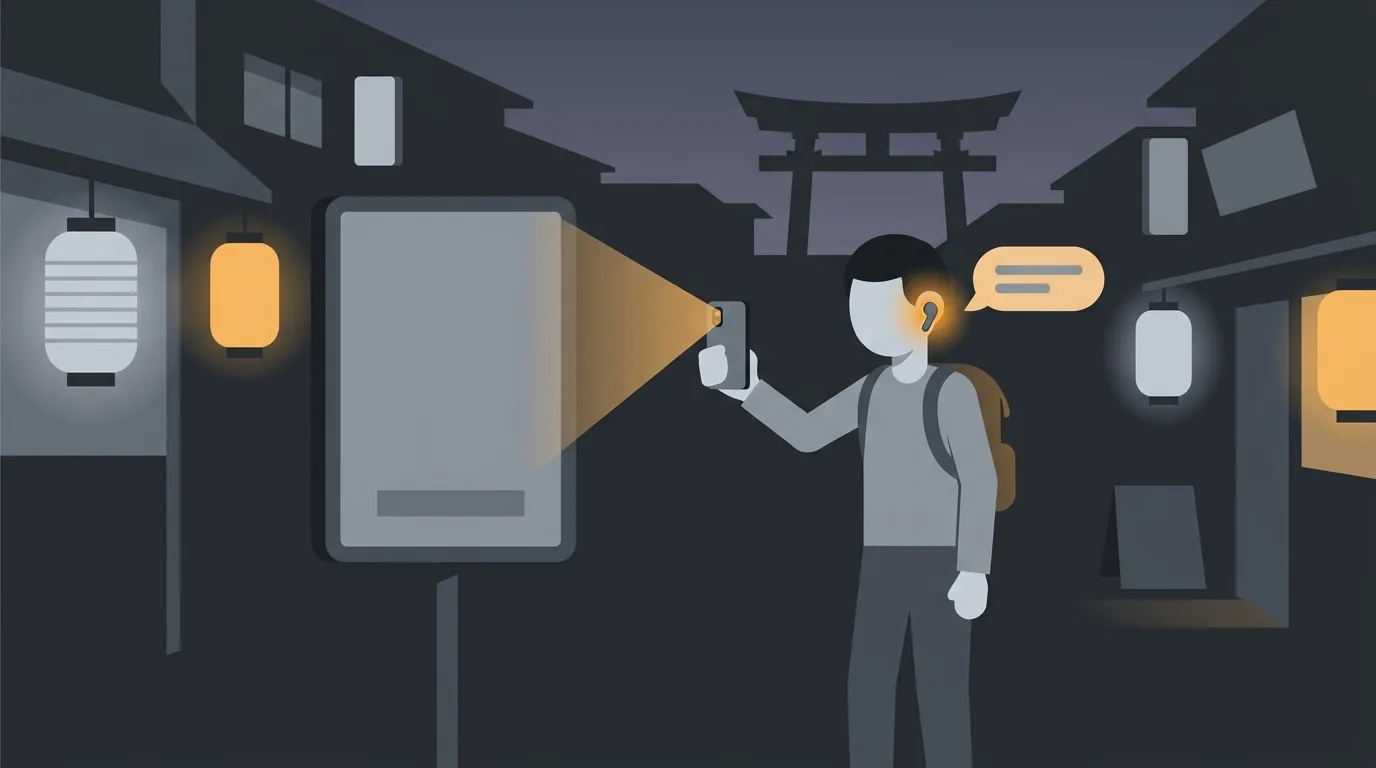
Before you buy anything for a trip to Japan, understand what you are actually going to struggle with. Most of your language problem in Japan is reading, not listening. Signs, menus, ticket machines, medicine boxes, the rubbish sorting chart in your hotel room, the fare table above the station gate. None of that is a conversation, none of it makes a sound, and no earbud in your ear will touch any of it. The tool for that is the camera you already own. Live speech translation, whether it runs through earbuds or your phone speaker, earns its place in a much smaller and much more specific set of moments: the izakaya counter, the pharmacy, the ryokan check-in briefing, the person who stops to help you when you are lost. Buy for that list, not for the trip as a whole.
I sell a translation earbud kit. Writing the paragraph above costs me sales in the highest-volume translation-travel market there is, and I write it anyway, because the alternative is selling somebody a device that sits in their bag for nine days while they squint at a menu.
What share of the Japan language problem is written, not spoken?
Do not take a percentage from me or from anyone else. Nobody has measured this, and any number you see attached to it was invented for a headline. Instead, count your own day.
Walk through a normal Tokyo or Kyoto morning. You wake up in a hotel room and there is a laminated card about breakfast times and a control panel on the air conditioner. You go to the station and there is a fare chart, a platform sign, a ticket machine, and a notice about which cars are reserved. You buy a coffee and the menu is a board. You go to a temple and the entry sign explains what you may and may not photograph. You have lunch and the menu is either a wall of kanji or a display case. You go into a drugstore for something for a headache and every box is text. You come back and there is a chart in the kitchenette showing which bin the plastic goes in.
Now count the moments in that same morning where a human being said something to you that you needed translated and could not resolve by pointing. Realistically: the lunch order, if you did not use the display case. That is often it.
This is not because Japanese people do not speak to you. It is because the country is built to be navigated by reading, and enormous effort has gone into making the written layer navigable. Major stations, airports and tourist sites carry English alongside Japanese as a matter of policy, and the Japan National Tourism Organization's planning guide is written on the assumption that a first-time visitor will get through transit, payments and accommodation largely on signage and cards rather than on conversation.
That leaves the written layer as the bulk of the work, and the written layer belongs to your camera. Google's own documentation for translating text with the camera in Google Translate covers exactly the job you will be doing forty times a day: point at a sign or a menu, capture, read. It works offline once you have downloaded the language, which matters more than it sounds like it does.
If you take one thing from this article and buy nothing, take that: download the Japanese pack before you leave.
Which moments actually need live speech translation?
The moments that genuinely need speech share three traits, and Japan produces a distinctive set of them.
The exchange is two-way. Not "what does this say" but an actual back and forth where the answer produces another question.
It runs long. Long enough that stopping to hold a phone between two faces, waiting for the beep, and passing it back becomes the dominant experience of the conversation rather than the conversation itself.
Your hands or your posture are committed. You are holding a tray, a suitcase, a child, a bowl, a prescription, chopsticks. Or you are sitting at a counter shoulder to shoulder with the person you are talking to, where holding up a phone would be strange.
In Japan those cluster in a handful of places. The counter at a small izakaya or sushi place, where the chef is in front of you and conversation is the actual product you are buying. The pharmacy, where you need to describe a symptom and understand the dosing instruction that comes back. Ryokan check-in, where somebody explains bath hours, dinner time, where to leave your shoes and when the front door locks, all in one uninterrupted paragraph. A long taxi or driver leg in the countryside. A cooking class, a workshop, a factory tour, a temple stay. And the specific Japanese experience of an older person deciding you look lost and walking you three blocks to the right corner while talking the whole way.
That is a real list, and it is why audio translation belongs on the trip at all. It is also obviously not nine days of activity. If your trip is Tokyo, Kyoto, trains between them, and restaurants chosen from photographs, your phone will do the entire job and you should keep the money. If your trip includes a homestay, a rural ryokan, a guide, family, a class, or business, the speech moments are the memorable parts of the trip and they are the ones worth equipping for.
The pattern is the same one I laid out in how translation earbuds actually work: the earbuds are a microphone and a speaker, and the translation happens in software elsewhere. What earbuds change is not accuracy. It is whether the conversation survives being translated. For a general version of this sorting exercise across any destination, translation earbuds for travel has the trip-day protocol.
One Japan-specific warning about the izakaya case, which is the one people most want it for: those rooms are loud, hard-surfaced, and full of overlapping speech, and that is the hardest environment there is for any speech recognition system, ours included. I wrote about why in translation earbuds in noisy places. Sit at the counter rather than in the middle of the room, and expect to repeat things.
How well does Japanese translate in practice?
Japanese to English is one of the harder major language pairs, and the reasons are structural rather than a matter of any one vendor trying harder.
Japanese drops the subject. English sentences need somebody to be doing the verb. Japanese sentences frequently do not include one, because the listener can infer it from context, from politeness markers, or from who is standing there. So a Japanese sentence that means "I'll bring it in a moment" and one that means "she'll bring it in a moment" can be identical strings, and the translation system has to guess. This is a well-studied problem with a name: linguists call the missing words zero pronouns, and there is a hand-built evaluation dataset for zero pronouns in Japanese to English translation precisely because standard scoring hides how often systems get the guess wrong. Practical consequence for you: watch out for pronouns in translated Japanese. If a translation tells you who is doing something, treat that part as the least reliable word in the sentence.
The verb comes last. Japanese word order puts the verb at the end, and the end is also where negation lives, and where politeness lives. "Ikimasu" is "I'll go" and "ikimasen" is "I won't go", and they differ only in the final syllables. Any system translating a stream of speech has to wait for the end of the sentence before it can commit, because the meaning can invert at the last moment. This is a real reason Japanese speech translation feels laggier than, say, Spanish, and it is not a defect in your equipment. It is the language. Do not interrupt the pause: let the sentence finish.
Three writing systems, and no spaces. Kanji, hiragana and katakana appear interleaved in ordinary text, with no spaces between words. Camera translation has to segment before it can translate, which is why it handles a clean printed station sign beautifully and struggles with a handwritten specials board in stylised brush script. Vertical text is a second problem. When your camera returns nonsense, it is usually not the translation failing, it is the character recognition failing, and the fix is a better photo, more light, and holding the phone square to the text rather than at an angle.
Counters and numbers behave differently. Japanese counts objects with a classifier that changes by the shape and category of the thing. Translations of quantities are a common failure point. The reliable move, at a shop counter or a market, is to type the number into your phone as digits and show it. Digits are the same in both languages and cannot be misheard.
None of this makes machine translation useless for Japanese. It is very good, and it has got better quickly. It means you should read its output as a strong hint rather than a transcript, and you should confirm anything that involves money, medicine, time or a train platform by a second method.
What politeness levels does machine translation miss?
This is the part that no comparison of apps mentions, and it is the part most likely to make you sound strange.
Japanese grammatically encodes the relationship between the speaker, the listener and the subject. There is plain form for friends and family. There is teineigo, the polite -masu and desu forms, which is the safe register for a visitor speaking to anybody. Above that sits keigo, which splits into sonkeigo, elevating the person you are addressing, and kenjougo, lowering yourself. Staff in shops, hotels and restaurants speak to customers in keigo constantly.
Two things happen when a machine sits between you and that system.
Translating into Japanese, the system has to pick a register and it does not know your relationship to the listener. Most engines default to polite teineigo, which is the right guess and is genuinely safe. But it means that when you meet your host's grandmother, or you are apologising, or you are speaking to somebody who has done you a considerable favour, the register will not rise to match. Your words will be correct and slightly flat. The fix is not linguistic: it is bowing, tone and slowing down.
Translating into English, the register is simply deleted. "Irasshaimase" shouted as you walk in, "shoushou omachi kudasai" from a receptionist, and a friend saying "chotto matte" can all come back to your ear as "please wait". The information content survives and the social information does not. So you lose the signal that tells you whether you are being formally welcomed, professionally handled, or spoken to as an equal.
Neither of these is a reason to skip translation. It is a reason to keep watching faces. The register lives in the bow, the volume, the hand position and the pause, and all of that is still visible to you with a device in your ear.
What should you set up before you land?
Do this on your sofa, not at Narita.
Download the Japanese offline language pack in your translation app, and confirm camera translation works with aeroplane mode on. That single step covers the largest category of problem you will have.
Sort out connectivity separately, because it is a different requirement. Offline packs handle the camera and basic text. Live speech translation, the good kind, runs against a cloud model and therefore needs a connection: an eSIM or a rental router, not hope. I went through what does and does not survive going offline in do translation earbuds need wifi. Japan has extensive public wifi, but it is not something to depend on mid-sentence at a pharmacy counter.
Save four things in your phone as screenshots, so they work with no signal at all: your accommodation's address in Japanese, any allergy or dietary restriction written out in Japanese, the generic name of any medication you take, and your passport photo page.
Test your audio setup on something real before the trip rather than in the taxi from the airport. On our home page there is a live demo you can run in your browser right now: pick Japanese, say a sentence out loud, and listen to what comes back. Do that before you decide whether you need anything beyond the phone in your pocket. It takes a minute and it will answer the question better than any article, this one included.
And learn five phrases. Not for translation: for signalling. Sumimasen (excuse me), onegaishimasu (please), arigatou gozaimasu (thank you), daijoubu desu (I'm fine, or no thank you), and nihongo ga wakarimasen (I don't understand Japanese). Those five open and close nearly every interaction you will have, and the last one, said politely, reliably produces help.
The printable Japan situation card
Twelve situations, the tool each one actually needs, and what to lead with. Screenshot it or print it. The point of the card is the middle column: three quarters of what you will do in Japan is not a conversation.
| Situation | Which tool | What to lead with |
|---|---|---|
| Restaurant menu with no photographs | Camera | Ask first: "Eigo no menyuu wa arimasu ka?" (Is there an English menu?). Many places have one. Camera only if not |
| Ticket machine or fare chart at a station | Camera | Look for the English button on the machine first, it is usually top right. Camera on the fare chart above the gate |
| Medicine, cosmetics or food packaging | Camera | Photograph the back panel, not the front. Ingredients and dosing are on the back |
| Hotel room panels: air conditioning, bath, rubbish sorting | Camera | Hold the phone square to the label and steady. Angled shots break character recognition |
| Handwritten specials board at an izakaya | Camera, then give up gracefully | Expect brush script to defeat it. Fall back to "Osusume wa nan desu ka?" (What do you recommend?) |
| Izakaya or sushi counter conversation | Speak | Open with "Osusume wa nan desu ka?" and let the reply run. This is a real conversation, treat it as one |
| Pharmacy, describing a symptom | Speak, plus written backup | Say the symptom, then show the generic drug name written down. Confirm dosing a second way |
| Ryokan or guesthouse check-in briefing | Speak, listening mode | Say "Nihongo ga wakarimasen, sumimasen" first so they know to slow down. Then just listen |
| Someone who stops to help you when you are lost | Speak | Lead with "Sumimasen" and the place name. Let them talk. Interrupting a helpful stranger to fix your earbuds ends the help |
| Ordering from a display case, ticket machine or counter | Just point | "Kore o kudasai" (this one, please). Point at the item or the photo. Faster and clearer than any translation |
| Paying, or asking for the bill | Just point | "Kaikei onegaishimasu" for the bill. Hold out the card. Put cash in the tray, not in the hand |
| Declining a bag, a receipt, chopsticks or extra service | Just point | "Daijoubu desu" with a small hand gesture. Do not translate a full sentence to say no |
Five camera rows. Four speak rows. Three rows where the correct answer is a gesture and four syllables. If your equipment plan does not match that shape, the plan is wrong.
What still works better than any device?
Pointing. Genuinely. At a display case, a photograph, a plastic food model in a window, or the item on the shelf. It is unambiguous, it is instant, and it is not rude in a shop.
Digits on a screen. Prices, quantities, times, platform numbers, party size. Type it, show it, done.
The English button. It is on the ticket machines, the ATMs, the self-checkout terminals and most restaurant tablets. People stand in front of these machines translating the Japanese interface with a camera while the button sits there.
Station staff. Japanese station staff are trained, present, and will physically walk you to the right platform. This is faster than any device and it is the intended system.
Written addresses. Show the driver the address in Japanese on your screen. Do not attempt to say it. Place names are where machine translation and machine pronunciation both fall apart, because Japanese place names have irregular readings that even software with excellent grammar gets wrong.
And for anything that has gone properly wrong, JNTO runs a visitor hotline that operates around the clock with English support, and the national emergency numbers are 110 for police and 119 for ambulance or fire. Those are on the JNTO planning pages alongside the rest of the practical detail. In a medical or legal situation, ask for a human interpreter and stop using a device. That advice is not about quality. It is about who is accountable for the words.
So where does our kit fit?
Honestly: in the four speak rows, and only if your trip contains several of them.
Our kit is a $69 earbud set plus AI Translation Live, our own browser speech-to-speech app, which is a $39 per year add-on and includes five hours of live translation. The earbuds are priced as hardware and described only by specs I can confirm, for the reasons in how translation earbuds actually work. What you are actually buying from us is the software layer and a straight description of what it does.
If your Japan trip is a week of cities, trains and restaurants you chose from photographs, buy nothing from anybody. Download the offline pack, learn the five phrases, and use the card above. You will be fine, and I would rather tell you that than take sixty-nine dollars for a box that stays sealed.
If your trip has counters, hosts, guides, a pharmacy visit, a rural inn, or family you have never met, run the demo on our home page in Japanese first. Say a real sentence, one you would actually need. Listen to what comes back and to how long it takes. Then decide.
Frequently asked questions
Do I need a translator for Japan?
Not a person, and usually not a dedicated device. You need a translation app with the Japanese pack downloaded, because the majority of what you cannot understand in Japan is printed and your camera handles printed text. Add live speech translation only if your itinerary contains sustained two-way conversations: a homestay, a guide, a rural inn, a class, business, or family. For a standard city itinerary, the phone in your pocket covers it.
Do translation earbuds work well with Japanese?
They work as well as the software behind them, which for Japanese means good but with known rough edges. Dropped subjects mean pronouns are the least reliable part of any translated Japanese sentence. The verb landing at the end of the sentence means the system must wait for the sentence to finish, so Japanese feels slower to translate than European languages. Politeness level gets flattened in both directions. Noise is the other constraint, and izakaya are noisy. What earbuds change is not the accuracy of the translation: it is whether a long conversation can happen at all without a phone being passed back and forth. That is the thing to buy them for.
Is Google Translate enough for Japan?
For most travellers, yes, and it is free. Its camera mode is the workhorse of a Japan trip and works offline once the Japanese pack is downloaded. Its conversation mode handles short spoken exchanges by taking turns and playing translations aloud. Where it gets awkward is a long conversation where the phone has to sit between two people, or one where your hands are full. That gap is narrow, and it is the only gap worth spending money on.
What's the best way to read a Japanese menu?
Ask for an English menu first, in Japanese: "Eigo no menyuu wa arimasu ka?" A surprising number of places have one behind the counter. If not, use camera translation on the printed menu, holding the phone square to the page in good light. If the menu is handwritten in brush script, character recognition will struggle, so switch tactics: ask "Osusume wa nan desu ka?" (what do you recommend?) and accept what arrives. Where there is a display case or plastic food models outside, use those instead. Pointing at the actual dish beats translating its name every time.