Translation for Mexico: Spanish That Sounds Right
By Mark Fulton · September 8, 2026
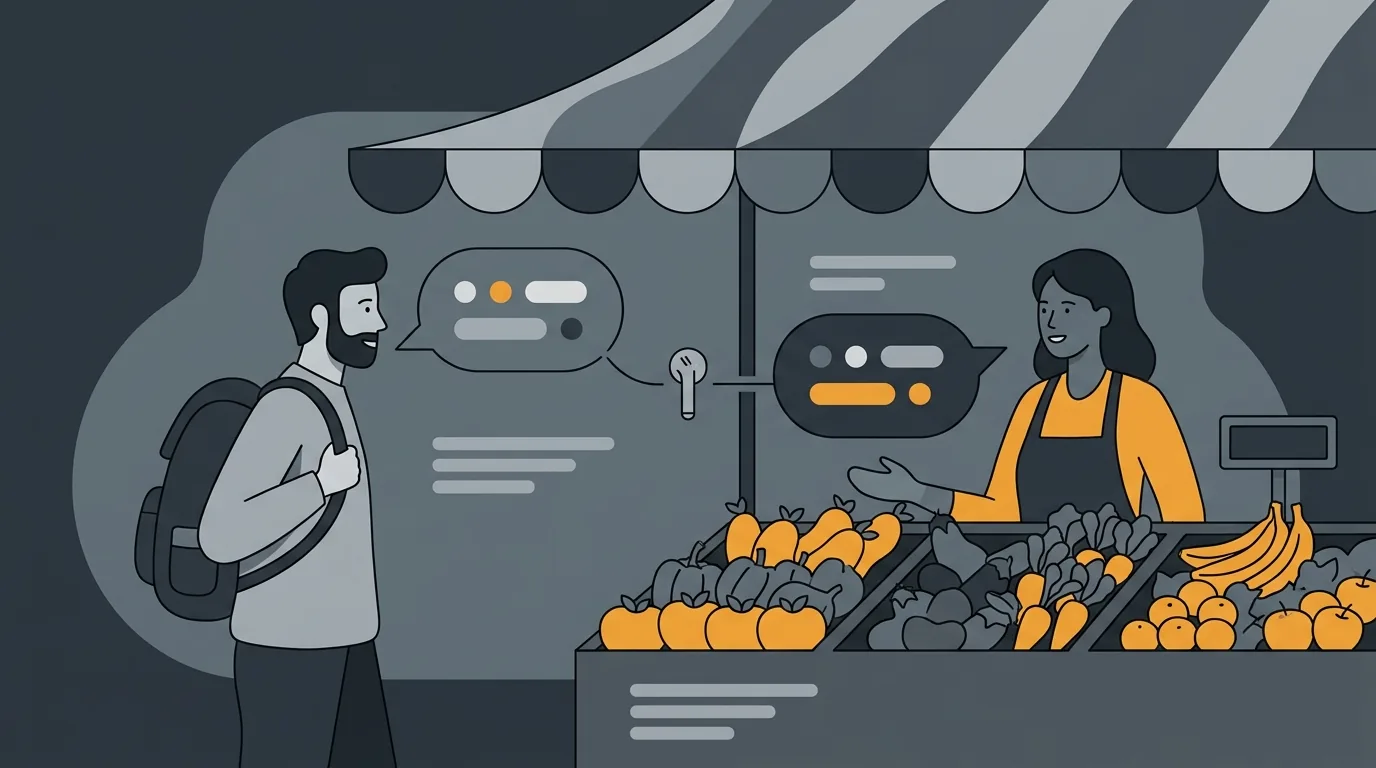
A translation app set to plain "Spanish" will get your meaning across in Mexico, but the words it hands back often sound like they were shipped from Madrid: "coche" instead of "carro," "ordenador" instead of "computadora," "vale" where nobody in Mexico City would say it. None of that is a bug. Most machine translation systems default to a neutral or Peninsular register unless you tell them otherwise, and "otherwise" is not always available to tell. The fix is not a better app. It is knowing which twenty or so everyday words carry the accent, and steering around the rest.
Why does translated Spanish sound wrong in Mexico?
Spanish has one grammar and roughly twenty national varieties of vocabulary, register and rhythm sitting on top of it. The Real Academia Española's own dictionary tags hundreds of everyday words with a country label, not because they are wrong outside that country, but because a Mexican, an Argentine and a Spaniard reaching for the same object will often reach for a different word entirely. A translation engine has to pick one default when it renders a sentence, and for historical and training-data reasons, that default has leaned Peninsular for years: "coche" for car, "ordenador" for computer, "zumo" for juice, "vosotros" for the plural you that nobody in Mexico uses in speech.
None of this makes the translation incorrect. A Mexican reader understands "coche" fine, the way an American reader understands "lorry" for truck. But it reads as slightly foreign, the linguistic equivalent of a menu translated into British English for a Texas diner. For a traveler trying to sound like they belong at a market stall in Oaxaca, that gap between technically-correct and locally-natural is the whole problem.
Which everyday words differ most?
The table below is built from confirmed regional entries in the Real Academia Española's own dictionaries: the Diccionario de la lengua española (DLE) and the Diccionario de americanismos, which the Spanish and Latin American language academies publish jointly and tag by country. Every row is a term the DLE or the Diccionario de americanismos explicitly marks as Mexican or broadly American usage, set against the word a generic or Peninsular-leaning translation is more likely to produce.
| You'll hear in Mexico | Generic/Peninsular translation | Meaning | Where it comes up |
|---|---|---|---|
| carro | coche | car | street, rental counter |
| manejar | conducir | to drive | rental counter |
| camión | autobús | bus | street |
| banqueta | acera | sidewalk | street |
| aventón | autostop | a ride, a lift | street, asking for help |
| popote | pajita | drinking straw | taquería |
| papas | patatas | potatoes, fries | taquería |
| frijoles | judías / alubias | beans | taquería |
| mesero / mesera | camarero | waiter / waitress | taquería, restaurant |
| chido | guay | cool, great (colloquial) | taquería, casual talk |
| curita | tirita | adhesive bandage | pharmacy |
| ahorita | ahora mismo / dentro de un rato | right now, or shortly, depending on tone | pharmacy, any waiting-in-line moment |
| recámara | habitación / dormitorio | bedroom | hotel desk |
| clóset | armario | closet | hotel desk |
| alberca | piscina | swimming pool | hotel desk |
| checar | comprobar / revisar | to check | hotel desk |
| rentar | alquilar | to rent | hotel desk, car rental |
| pluma | bolígrafo | pen | hotel desk (signing in) |
| computadora | ordenador | computer | hotel business center |
| chamarra | cazadora | jacket | shopping |
A few of these are worth a second look because they can actually cause confusion rather than just sounding foreign. "Ahorita" is the classic one: it is the diminutive of "ahora" (now), but the Diccionario de americanismos defines its core sense across Mexico and most of Latin America as "dentro de un momento, más tarde" (in a moment, later), not strictly immediate. A pharmacist who says "ahorita lo atiendo" may mean anywhere from thirty seconds to twenty minutes. Standard-Spanish training data tends to gloss "ahorita" as "right now," which sets the wrong expectation. "Camión" is the other trap: outside Mexico it usually means truck, but the DLE carries a specific Mexican sense meaning city bus, so a translated sentence about catching "el camión" downtown is not about cargo.
The Instituto Cervantes documents several of these same patterns independently in its own catalog of regional speech, noting Mexico City vocabulary such as "banqueta" for sidewalk alongside grammar features like the regional use of "hasta" to mark when something starts rather than when it ends ("abren hasta las nueve" can mean they don't open until nine, the reverse of what a Peninsular speaker would assume).
Can you steer a translation model toward a region?
Partially, and it depends which product you are using. Google's Cloud Translation API documentation lists "Spanish (Mexico)" as its own supported language code, es-MX, distinct from generic es or es-ES for Spain. That means the underlying technology is capable of targeting Mexican Spanish specifically when a developer builds it into an app. The free consumer Google Translate website and app, however, generally expose a single "Spanish" option in the everyday interface rather than a Mexico-specific picker, so most travelers typing into the box get whatever the model's default output happens to be, not a variant they explicitly chose.
The practical version of "steering" that works for a phone or an earbud app in the middle of a conversation is simpler than picking a model setting: feed in the Mexican word yourself. If you type or say "¿dónde está la banqueta?" instead of "¿dónde está la acera?", most engines will translate the sentence correctly and often mirror the register back in later turns of the same conversation. Steering a translation model wholesale toward a dialect is a research problem. Feeding it the right input word for the next thirty seconds is something you can just do.
Where does formality trip travellers up?
Mexican Spanish keeps the "tú/usted" distinction that some translation defaults soften or drop. "Usted" is the polite, distant form, used with anyone older, anyone in a service or official role you don't know personally, and pharmacists, hotel staff and market vendors you've just met. "Tú" is for peers, friends, and children. A translated phrase that defaults to "tú" because it's shorter or more common in casual training data can land as presumptuous when you're addressing a pharmacist or a hotel manager.
The safer default when translating a question or request for a stranger is "usted" conjugation: "¿me puede ayudar?" rather than "¿me puedes ayudar?" It costs nothing extra and is never read as too formal in a service interaction. If a translation app hands you the "tú" form for a sentence aimed at someone you've never met, mentally bump it up a register before you say it out loud.
What works best at markets and street food?
Markets and taco stands are loud, fast, and transactional, which is exactly the environment where a phone screen is slower than pointing and a full sentence is slower than a single word. The vocabulary that actually gets used in that setting is short: "papas," "frijoles," "una más," "para llevar" (to go), "¿cuánto?" You don't need a translated paragraph, you need the right two or three words delivered without fumbling for a phone.
This is also where a hands-free earbud setup earns its keep over a phone app, and where it doesn't. A conversation-mode earbud that translates a vendor's spoken price back to you while your hands are full of a plate is genuinely useful, and it's the scenario our own kit is built around: hardware for the hands-free moment, paired with AI Translation Live, the browser-based speech-to-speech engine that handles the actual translation. But for reading a handwritten menu board or a printed sign, a phone's camera translation is faster than anything spoken, earbuds included. Use the tool that matches the input: spoken words to earbuds, printed words to a camera.
What should you learn instead of translating?
A dozen phrases memorized cold will get you further in a taquería than any translation tool, because they remove the lag entirely. "Buenas," "por favor," "gracias," "¿cuánto es?," "para llevar," "sin cebolla" (no onion, useful for anyone with an allergy or preference), "la cuenta, por favor," and "una más" cover the large majority of a street-food transaction without needing to wait on any device. Learning the "usted" form of two or three basic requests ("¿me puede ayudar?", "¿me puede decir…?") solves the formality problem above without thinking about it in the moment.
Where a translation tool earns its place is the long tail: the pharmacist explaining dosage, the hotel desk clarifying a booking issue, the moment a conversation goes somewhere you didn't prepare a phrase for. That is a real and recurring need, not a hypothetical one, and it's a fair reason to carry a translation app or earbud kit even if you also memorize the basics. It is also where the honest limits of any tool, ours included, matter more than the marketing: no earbud, ours or a competitor's, is going to catch every regionalism in a fast, slangy conversation between two locals. It will do fine on a clear, direct exchange at a counter.
If you're already carrying language-learning apps like Duolingo or a phrasebook, they cover the memorization half well. Translation tools are for the sentences you didn't study for.
Frequently asked questions
Does Google Translate use Mexican Spanish?
Google's Cloud Translation API documentation lists "Spanish (Mexico)" as a distinct supported language variant, code es-MX, separate from Spain's es-ES and generic es. That confirms the underlying technology can target Mexican Spanish specifically. The free consumer Google Translate app and website, though, typically present a single "Spanish" option in everyday use rather than a Mexico-specific selector, so what you get by default is the model's general output rather than a variant you chose. If you want output that leans Mexican, feeding it Mexican vocabulary in your own input (asking about the "banqueta" rather than the "acera") tends to pull the response in that direction.
Do I need a translator in Mexico?
Not for most of a trip. English is widely understood in tourist areas, hotels, and larger restaurants, and a short list of memorized Spanish phrases covers ordering food, asking prices, and basic pleasantries. A translation app or earbud kit earns its keep for the specific moments outside that: a pharmacy conversation about medication, a detailed hotel or transportation issue, or any exchange where getting the details exactly right matters more than getting the gist.
How do I get more natural Spanish translations?
Feed the tool Mexican vocabulary rather than relying on it to guess the region: use "camión" instead of "autobús," "carro" instead of "coche," "ahorita" with the understanding that it means "soon" rather than "instantly." Default to "usted" conjugation when addressing someone you don't know. And treat any single translation as a starting point rather than a guaranteed-natural sentence, the same way you would with a translation into any language you don't speak.
Are translation earbuds useful in Mexico?
For the same narrow set of situations where any translation tool is useful: pharmacy conversations, hotel and transportation issues, and any exchange that runs longer than a memorized phrase can cover. They add real value in hands-free, spoken moments, like a vendor answering a question while you're holding food. They add little over a phrasebook for short, predictable exchanges you can just memorize, and they don't replace a camera for reading printed Spanish. AI Translation Live is built around the spoken side of that split; a phone's built-in camera translation still wins for signs and menus.
If you want to see how the output actually sounds before you rely on it, try a few of the phrases from the table above in the live demo: ask for "la banqueta," order "papas" instead of "patatas," and see how naturally the response comes back.
Sources: Diccionario de la lengua española, Real Academia Española (entries for carro, camión, banqueta, manejar, papa, curita, clóset, mesero), Diccionario de americanismos, ASALE (entries for ahorita, chamarra, checar, rentar, pluma, computadora, recámara, popote, mesero, curita, clóset), and the Instituto Cervantes catalog of regional Spanish speech for Mexico City vocabulary and grammar patterns. For more on how translation vocabulary claims hold up in general, see our breakdown of what "144 languages" actually means, and for the wider trip-planning picture, what to pack for a translation-heavy trip.