Vasco E1 vs Timekettle W4 Pro: Premium Earbuds Compared
By Mark Fulton · October 6, 2026
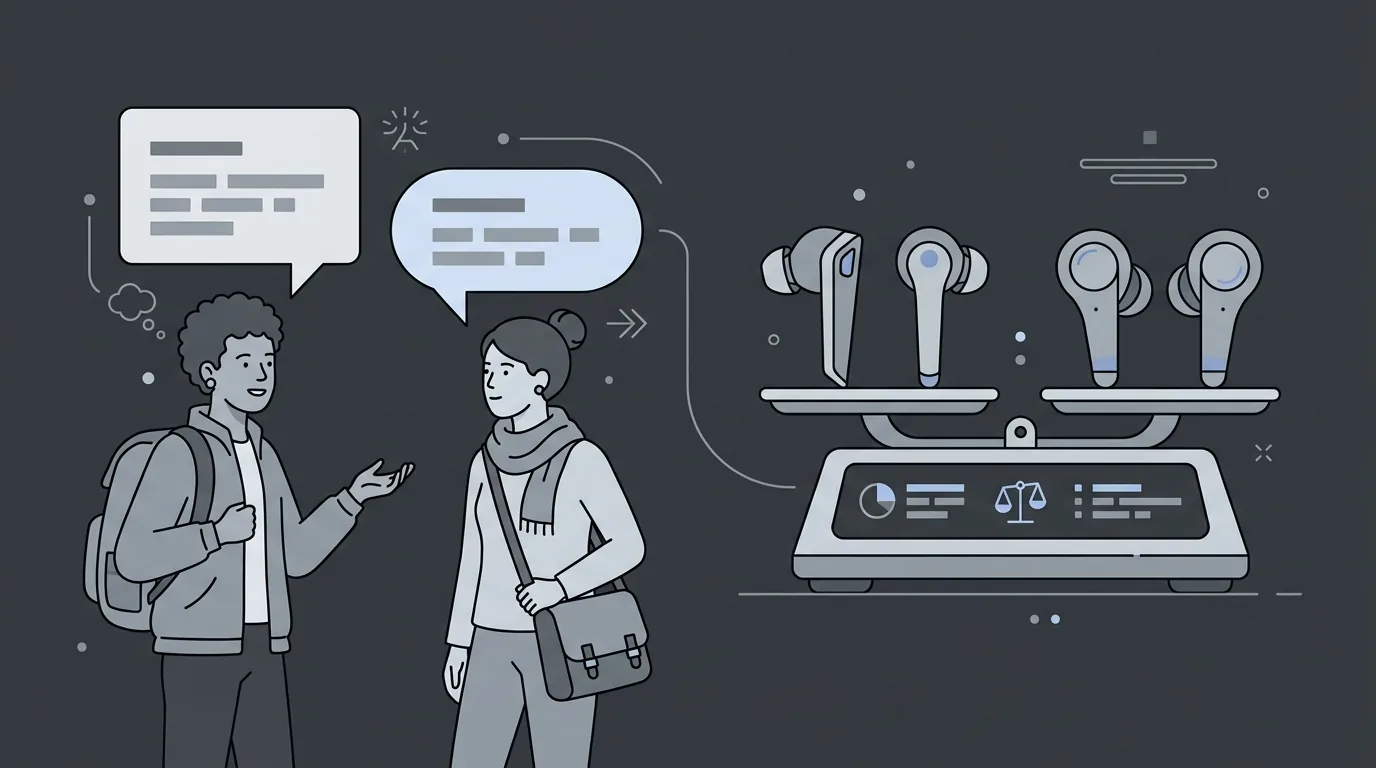
If you want the simplest handover and no recurring fee, the Vasco E1 is the better fit. If your day is mostly meetings and calls, the Timekettle W4 Pro is built for that. On 6 October 2026 Vasco listed the E1 at $389 and Timekettle listed the W4 Pro at $449. The E1 is a pair of over-ear pieces designed so one goes to the other person, and both brands list no subscription for core translation. The W4 Pro lists more: phone call and video translation, saved audio, and offline packs for a few language pairs. Neither one works on its own, because both need an app on your phone. If you only need a translator a few times a year, the free tools you already own may cover it, and I explain where our own kit fits at the end.
Everything below was read from Vasco's and Timekettle's own product pages, WIRED's review of the E1 and How-To Geek's review of the standard Timekettle W4, all on 6 October 2026. I sell a competing translation kit, so I have kept to things you can check yourself. Where I could not confirm something, I say so rather than guess.
What does each flagship bet on?
The two products make different bets on how a translated conversation should feel.
Vasco's bet is on handing someone an earpiece. The E1 is two loop-over-the-ear pieces that sit outside the ear canal, which Vasco says makes them hygienic and safer to share. One piece is for you and one is for the person you are talking to. WIRED's reviewer, Christopher Null, described the same design: two looping earpieces meant to be shared between you and someone speaking a different language. Vasco lists each piece at 12.5 grams, and both are made for the right ear only.
Timekettle's bet is on the app and the situations around the conversation. The W4 Pro is an open-ear design with the same one-earbud-each idea, but Timekettle's pitch leans toward business. Its page lists phone call translation, video translation, saved audio and text, and an AI memo export. It also lists a Listen & Play mode that Timekettle describes as built for fast exchanges in on-site meetings.
So the real question is not which has the better specs. It is whether your conversations are mostly with one stranger who will take an earpiece, or mostly meetings, calls and video where you want the words saved.
How do price and ongoing costs compare?
Here is the side-by-side. Every cell is a published figure with its source named, as read on 6 October 2026.
| Vasco Translator E1 | Timekettle W4 Pro | |
|---|---|---|
| Published price | $389 on Vasco's store, the same figure WIRED printed in its review | $449 on Timekettle's store |
| Connection | Pairs to the free Vasco Connect app on a phone, or to a Vasco handheld translator | Needs the Timekettle app on a smartphone, per Timekettle's FAQ |
| How the second earpiece is meant to be used | Over-ear piece, designed to be shared and handed over | Open-ear design, which Timekettle says makes sharing easy and hygienic |
| Listed modes | Earbuds mode (with a touchless option), Loudspeaker mode, group mode | One-on-One, Listen & Play, and multi-media translation |
| Languages as listed | 51 | 52 languages and 106 accents |
| Group use | Up to 10 earpieces on a phone | Not listed |
| Offline | Not listed on the E1 page | 8 languages as 13 pairs, per Timekettle |
| Subscription | None, per WIRED | None for the product, per Timekettle's FAQ, with some caveats below |
| Return window | 30-day return policy | 30 days returns and a 12-month warranty |
| Battery as listed | WIRED cites 3 hours per earbud. Vasco's page gives no hours figure | Up to 6 hours of continuous translation, per Timekettle |
Two things in that table need a closer look.
First, the language counts are not like for like. WIRED noted that the E1's 51 languages include several regional variations of English, such as UK, US, Indian and Australian. Timekettle's 52 languages come with 106 accents, which is the same kind of padding in a different form. I went into why these counts are slippery in what "144 languages" actually means. Whichever number you see, check the one language pair you need.
Second, "no subscription" has fine print on the Timekettle side. Its FAQ says all features are included with a one-time purchase. It also says two pairs of offline language packs are free via coupons, after which they cost $10 per pair, or come with a paid subscription. And the comparison table lower on the same page marks audio and video translation and call translation between two devices as optional on iOS, included in a $14.99 monthly plan. Those two statements sit on the same page and I could not reconcile them. If calls and video are why you want the W4 Pro, ask Timekettle in writing before you pay. For Vasco's side of the money question, see does a Vasco translator need a subscription.
How does each handle the second person's earpiece?
This is where the two feel most different, because the second earpiece is the whole trick. Without it, you are holding a phone out to a stranger.
The E1 was designed around the handover. The over-ear shape means the piece does not go into anyone's ear canal. Each earpiece can be assigned its own LED colour in the app, so you can tell whose is whose in a group. WIRED liked the workflow but flagged a learning curve. In Earbuds mode you tap the side of your earbud to talk, and a translation is delivered to the other earbud after a pause. The reviewer said his early tests sometimes sent a translation in the wrong language because of his own mistakes. There is also a touchless version where nothing needs tapping, but in WIRED's testing it made for a slightly less accurate translation.
The W4 Pro also uses one earbud per person in its One-on-One mode, where Timekettle says both people can speak and hear at the same time. Timekettle's open-ear design means the piece rests on the outside of the ear rather than sealing it. I could not find an independent review of the W4 Pro itself in a form I could read in full, so I cannot tell you how well that handover works in practice. What I can report is on the standard W4, a different and cheaper model. How-To Geek's reviewer found the W4's semi-in-ear buds slipped out of his ear every few minutes, which is a fit problem specific to that design. Whether the Pro behaves the same I cannot confirm.
Which suits meetings and which suits travel?
Taken at face value from the product pages, the split looks like this.
Meetings and calls lean Timekettle W4 Pro. Timekettle lists translation for phone calls, video and online meetings with subtitles, and saved audio and text you can review after. It also lists a personal glossary for custom terms. If you run calls with someone in another language and want a transcript afterward, those are the features on the page that point at your use. The caveat is the iOS plan wording above.
Group conversations and handover lean Vasco E1. Vasco says you can connect up to 10 earpieces to one phone, and the E1 keeps working with the phone screen off. That is useful at a wedding, a class or a family dinner, where several people each want an earpiece. Vasco also sells a separate Audience app that broadcasts a speaker's words to listeners' phones, but that is a different product and I have not tested it.
Travel splits on connection. An earpiece on its own needs your phone's data. Vasco says that pairing the E1 with one of its handheld translators brings lifetime internet for translations in nearly 200 countries, and 85 supported languages, but those are the handheld devices at a higher total cost, and I am quoting Vasco's own claim. Timekettle lists offline packs for a few pairs involving English, Chinese, Japanese, Korean, French, Spanish, Russian and German. If your pair is not one of them, you are online either way.
For a longer look at meeting use in general, see translation earbuds for business meetings.
What do independent reviewers and owners say?
I can only cite what I could open and read in full.
WIRED reviewed the E1 in January 2025 and scored it 7 out of 10. Its summary put the good side as the most impactful translation system the reviewer had tested, with no subscription needed. The bad side: a slight learning curve in the app, hardware that is not the most attractive, earbuds that fit the right ear only, and a Loudspeaker mode that cannot translate uninterrupted speech. The reviewer also wrote that he was astonished by the accuracy of the translations, as long as he spoke very clearly and was patient. WIRED's review of the Vasco Translator E1 is worth reading in full for the mode-by-mode detail.
For Timekettle, the independent review I could read was of the standard W4, not the Pro. How-To Geek's Timekettle W4 review was critical. The reviewer said the W4's accuracy was enough to get an idea of what the other person was saying, but not enough for confidence, with some words misheard and some phrasing awkward. He tested it in Telugu with his wife and found the output overly formal. The review also says the W4 Pro adds multimedia translation, which the reviewer could not test, and found the W4 itself unable to keep up with a TV show. So read it as a signal about the family, not a verdict on the Pro.
Timekettle's store also shows a star rating, but a store rating is the seller counting its own reviews, and I would not buy on that alone.
One more honest limit: Timekettle's own page claims things like a 50 percent drop in recognition errors against its previous earbuds. That is the manufacturer comparing its own products, so treat it as a claim, not a measurement.
Is either worth four times a budget pair?
The honest answer depends on how often you will actually have a conversation worth translating.
A $389 or $449 pair makes sense if you meet people across languages every week, in person or on calls, and a missed detail costs you something. It also makes sense if you want the hardware to keep working with no yearly fee, which is Vasco's pitch and, for core features, Timekettle's. Neither promises a conversation as smooth as two people sharing a language. Both reviewers I read said you need to speak slowly, pause, and expect misses.
It makes less sense if you will use it on one trip a year, because even at the lower price you are spending several hundred dollars for a few conversations about directions and menus. Our own kit is $69, and our browser speech-to-speech app, AI Translation Live, is $39 a year with 5 hours included. That is $108 in the first year, so a premium pair costs roughly four times as much. I am not claiming our hardware does what the premium pairs do. The difference is the software, which you can hear working before you spend anything. If you want to compare, say a sentence into the demo on our home page, then say it into your phone's free translation tool. If the free tool is good enough for your language pair, you may not need to buy anything, ours included. If you do want to try Live with your own headphones, the Live page spells out what it covers.
For a wider price and spec read across the brands, see Timekettle vs Vasco vs Pocketalk, and for how Timekettle's cheaper models differ, Timekettle W4 vs WT2 Edge.
FAQ
Which is better, the Vasco E1 or the Timekettle W4 Pro?
It depends on the job. The E1 is the better fit if you hand an earpiece to strangers or family and want no subscription, and it lists group use for up to 10 earpieces. The W4 Pro is the better fit if you work through calls, video and meetings and want saved audio and text. WIRED scored the E1 7 out of 10, and I could not read an independent review of the W4 Pro itself, so I cannot call a winner on accuracy.
Does the Vasco E1 need a phone?
Yes, on its own. WIRED said the Vasco Connect app on your phone is what does all the work. Vasco says you can instead connect the E1 to one of its handheld translators, which is a separate purchase.
Does the Timekettle W4 Pro have a subscription?
Timekettle's FAQ says no subscription is required for the product, and two pairs of offline packs are free before $10 per pair applies. The comparison table on the same page lists a $14.99 monthly plan that covers some optional iOS call and video features, so confirm what you get before buying.
Are premium translation earbuds worth it?
If you have cross-language conversations often and a misunderstanding has a cost, a premium pair can pay for itself. If you need it a few times a year, test the free translation tools on your phone first, since even the reviewers I read said you must speak slowly and expect mistakes.