Translation at Work: Tools for Multilingual Teams
By Mark Fulton · September 10, 2026
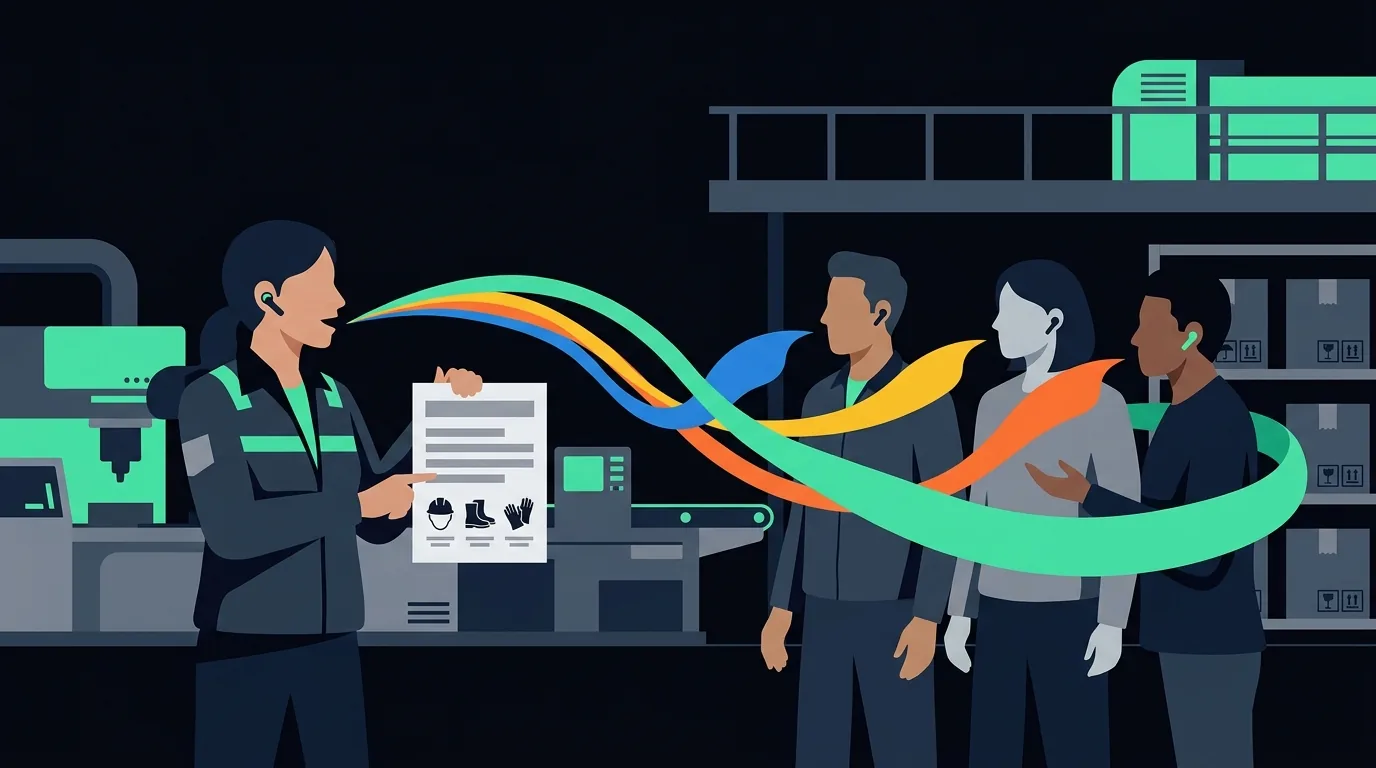
If you run a shift where two or three people cannot follow the briefing, here is the short version before the detail.
Fix the process before you buy anything. A large share of workplace language failures come from instructions that were never written down, handovers delivered verbally at speed, and nobody knowing who to ask when they miss something. Those are free to fix and they remove more misunderstandings than any device will. After that, live translation genuinely earns its place in the conversations you cannot reduce to a document: the toolbox talk, the one-to-one check-in, showing a new starter how a machine actually behaves, the confused half-minute in the middle of a shift. Two things stay in writing no matter what you buy. Safety and hazard instructions, translated properly and confirmed. And anything with a consequence attached to it: pay, hours, discipline, contract terms. Have the consent conversation before the first earbud goes in anyone's ear, not after.
I sell translation earbuds, so take the buying advice below with that in mind. I have tried to write the parts that cost me money as plainly as the parts that do not.
What in a language barrier isn't a translation problem?
Three things get called a language barrier that are really something else, and all three are cheaper to fix than they look.
Information that only exists in someone's head. If the correct way to change over the line lives in a supervisor's memory and gets transmitted by talking, everyone is dependent on catching it in real time. A fluent English speaker who is tired or distracted misses it too. They just cover for it better.
Speed, jargon and acronyms. Someone can be perfectly functional in English and still lose a sentence delivered at native pace with three site acronyms and an idiom in it. This is the most common one and the least acknowledged, because the person on the receiving end usually nods rather than stopping the conversation.
No safe route to ask a question. If asking twice feels like admitting you cannot do the job, people stop asking. That is a culture problem wearing a language problem's clothes, and no device fixes it.
There is also a legal floor under all of this that most workplace advice skips. In its Training Standards Policy Statement of 28 April 2010, OSHA set out its position that an employer "must instruct its employees using both a language and vocabulary that the employees can understand," that if an employee does not speak or comprehend English then "instruction must be provided in a language the employee can understand," and that "if employees are not literate, telling them to read training materials will not satisfy the employer's training obligation." The same memorandum notes that courts and the Review Commission have agreed an employer may not lean on an adequately communicated work rule that it never actually communicated to a non-English-speaking employee in a language that employee could understand.
Read that as a to-do list rather than a compliance headache and it points at the free fixes:
- Write down the ten instructions you find yourself repeating, and put a picture next to each one.
- Get those ten translated properly, by a person, once. Ten short documents is a small, one-off cost.
- Slow the handover and make it a list, not a monologue.
- Name one person on each shift whose explicit job is to be asked, and say their name out loud in the briefing.
- Stop using acronyms in safety-relevant sentences. All of them, not most.
- Replace "does everyone understand?" with "tell me what you are about to do." A nod is not evidence.
Do those six and you will remove a category of failure that no translation tool touches, because the words were never clear in the first place.
Which conversations at work actually need a device?
After the written layer is in place, sort what is left by two questions: is it repeatable, and does it have a consequence attached?
| Conversation | Repeatable? | Best tool |
|---|---|---|
| Standing work instructions, changeover steps, PPE rules | Yes | A translated written document with pictures, reviewed by a human |
| Daily briefing, toolbox talk, shift handover | Partly | Written list plus live translation for the questions afterwards |
| Showing a new starter how a machine actually behaves | No | Live translation, one to one, in the real environment |
| A supervisor asking why the line stopped | No | Live translation |
| Return-to-work chat, first-week check-in, general rapport | No | Live translation |
| Someone at the gate: a driver, a contractor, a delivery | No | Live translation, with a sentence of explanation first |
| Pay, hours, scheduling changes, discipline, terms | Yes | In writing, and an interpreter if it is a discussion rather than a notice |
| An incident investigation or anything that will be relied on later | No | A qualified interpreter |
The middle rows are where a device does real work, and they have a shape in common: two people, taking turns, low stakes, and either side can say "again, sorry" without it costing anything.
The rows where it struggles have a shape too. Several people talking over each other is the hardest case in this whole category, because the recognition step has to decide where one speaker ends before anything can be translated. We went through that in detail in translation earbuds for meetings, and the structural fixes there apply on a shop floor as much as in a conference room: one speaker at a time, name the person before you address them, and keep turns short.
Noise is the other one. A busy plant floor, an engine bay, a kitchen at service. Speech recognition is upstream of translation, so if the microphone mishears the words, a perfect translation model will confidently translate the wrong sentence. Test in the actual environment before you decide anything, not in the office.
What must never be delivered by machine translation?
The honest reason to keep safety instructions in writing is not that machine translation is bad. It is that its quality varies enormously by language, and the output gives you no signal about which case you are in.
The clearest public measurement of this comes out of emergency medicine. A pragmatic assessment of machine-translated discharge instructions, published in the Journal of General Internal Medicine, had twenty bilingual community volunteers evaluate 400 machine-translated versions of twenty short, plain instructions across seven languages. Overall, the meaning was retained in 82.5% of them. The spread underneath that average is the part that matters: 94% in Spanish, 90% in Tagalog, 82.5% in Korean, 81.7% in Chinese, 67.5% in Farsi and 55% in Armenian.
Two things follow directly for a workplace.
First, the language your team actually speaks decides your risk, and it may not be one of the well-served ones. The languages with the fewest speakers online are frequently the languages of the people with the least access to a professional translator in the first place. That is the same pattern in both directions.
Second, the failures do not announce themselves. The researchers found that when they generated Farsi worksheets, the right-to-left directionality was not handled and the text came out transposed and illegible to the reader, while looking like ordinary output to the person who produced it. Their own conclusion was blunt: accuracy varies by language and machine translation should not be relied on for patient instructions. That was written about a hospital, but the mechanism is identical anywhere the words carry a physical consequence.
So, the two channels that stay in writing:
Safety and hazard instructions. Written, translated by a person or reviewed by one, posted where the work happens, and confirmed by teach-back rather than by a nod. A device is a fine way to answer the questions that follow the briefing. It is not the way to deliver the briefing.
Anything employment-consequential. Pay, hours, overtime, scheduling changes, warnings, terms, anything a person might later need to point at. Put it in writing in both languages. If it is a two-way discussion rather than a notice, book an interpreter. The reasoning is the same one we set out for hospitals and caregivers: the moment the conversation creates an obligation, a fluent-sounding machine output is not enough, and it is not enough precisely because it sounds fluent.
What does a per-person kit cost against a platform seat?
Start with what is checkable. Most of the workplace translation platforms marketed at frontline teams do not publish a price at all. The pattern across their pages is a demo request or a quote form, which is a normal enterprise motion and not a criticism. It does mean that for a supervisor with three people and no purchasing authority, the first step is a procurement conversation rather than a purchase.
The dedicated hardware that does publish prices sits high. Checked on their own sites on 10 September 2026: the Vasco Translator E1 lists at $389 with a $349 promotional price, and the Timekettle W4 Pro lists at $449. Three of either is over a thousand dollars before anyone has spoken a word.
Ours, stated plainly so you can do the arithmetic yourself:
| Item | Price |
|---|---|
| AI Translation Live Kit (earbuds) | $69 per person |
| AI Translation Live, 12 months | $39 per person per year, 5 hours of live translation included |
| Top-up | $19 for 5 more hours, one-off, nothing renews |
Now the part a vendor page would not tell you. Five hours a year is a travel-and-occasional allowance, and daily workplace use will exceed it. Ten minutes of translated conversation a day, five days a week, is roughly 43 hours across a year. Take off the included 5 and that is about eight top-ups, so call it $39 plus around $150, plus the $69 kit. Somewhere near $260 for the first year, per person, for a genuinely heavy user.
If that is your pattern, get a quote from one of the platforms and compare it honestly. At real daily volume across a whole crew, a per-seat contract may well come out cheaper, and it will come with the deployment, audit and device-management machinery a per-person kit does not have. Live translation costs real money per minute for everyone selling it, which is the whole argument we laid out in what translation subscriptions actually cost. Any product that appears not to be charging you for it is capping you, running a weaker model, or both.
Where a $69 kit wins is the specific case the platforms are badly shaped for: a small number of people, starting this week, on a budget that does not require a purchase order.
How do you introduce this without singling people out?
This is the step that decides whether the kit gets used or ends up in a drawer, and it is entirely about framing.
Issue it to the team, not to the people you think need it. Wear one yourself in the first briefing. The message is that the briefing now works in both directions, not that three named people have been identified as a problem. It costs you two extra kits and it changes the meaning of the whole exercise.
There is a legal reason to be careful here as well as a human one. The EEOC's enforcement guidance on national origin discrimination, issued in November 2016, treats restrictive language policies as a live risk area. It notes that an English-only rule adopted to avoid hearing other languages in the workplace, to manufacture grounds for discipline, or to make life uncomfortable for non-English speakers is unlawful disparate treatment, and it quotes the view that such a rule is "likely in itself to 'create an atmosphere of inferiority, isolation, and intimidation.'" A rule may be permitted where it is genuinely necessary for safety or efficiency, but not one applied selectively to some languages and not others.
Translation tooling is the opposite move from an English-only rule, and it is worth saying that out loud when you introduce it. You are not restricting how people speak. You are removing the penalty for speaking the language they think in. Keep it that way in practice: never log who uses it and how often, never let it appear in a performance conversation, and let anyone opt out without explaining why.
How do you roll this out to a small team in five steps?
This is the whole deployment. It takes about a week of calendar time and no IT ticket.
| Step | What you do | What "done" looks like |
|---|---|---|
| 1. Write the standing instructions down | Take the ten things you repeat most. One page each, short sentences, a picture per step. Have them translated by a person, or machine-translated and then read back by a fluent speaker who can flag what is wrong. | The documents exist in both languages, and someone who speaks the second one has read them and signed off. |
| 2. Have the consent conversation | Before any device is issued. Say what it does, what it does not do, and that using it is a choice. Cover: is anything recorded and where does the audio go; is it stored; is it optional; who do you tell if you want to stop. Also agree the rule for outsiders: if a conversation involves someone who is not on the team, you say what the device is doing before you use it. | Everyone in the room has said yes out loud. You have written down the date and who was present, in your own notes. |
| 3. Issue one kit per person | Not one for the shift. Shared kits become nobody's kit and the hygiene question kills them. Fix the language pair rather than relying on auto-detect, which guesses badly on short utterances in noise. Test in the real environment, at the real noise level, not in the office. | Each person has their own, has used it once, and can start a session without help. |
| 4. Run one real conversation with a safety net | Pick something low-stakes and non-binding. Have the bilingual colleague you have been informally leaning on sit in for that first one and confirm the output matched the intent. | The colleague says the meaning came through. If it did not, you found out on a conversation that cost nothing. |
| 5. Keep the two written channels open permanently | Safety and hazard instructions stay written, translated and confirmed by teach-back. Employment-consequential items stay written. Neither one becomes device-only, ever, including after the device has been working well for six months. | Nothing on that list has been delivered by device alone. Check this at three months, because this is the step that quietly erodes. |
Step 5 is the one that fails. Steps 1 through 4 are a project with a finish line. Step 5 is a standard, and standards drift when the tool starts working well and everyone gets comfortable.
How do you check it's working?
Four checks a supervisor can actually run, none of which require a dashboard.
Questions per shift should go up, not down. This is counter-intuitive and it is the best single signal. If people who previously said nothing start asking things, the barrier moved. If the shift goes quiet, either it is not being used or it is being used to nod along faster.
Teach-back, not "do you understand?" Ask the person to describe what they are about to do, in their own words, through the device if they like. This catches the silent failure mode, where a fluent-sounding translation dropped a negation and nobody in the room could tell.
Watch rework and near-misses on the specific tasks you translated. You know which two or three jobs generate the recurring mistakes. Those are your measurement, not an engagement number.
Ask directly at thirty days. One question: what is it good for and what is it useless for? If the answer is "nobody uses it," the cause is almost always fit, noise, or a consent conversation that did not land, in that order. All three are fixable and none of them are about translation quality.
And the honest limits. If the work happens in mandatory hearing protection, or under a mask, or in noise loud enough that you already shout, earbuds are the wrong shape for the problem and written instructions plus a bilingual colleague will beat them. If you need central deployment, audit trails, single sign-on and device management, a per-person kit is the wrong architecture and a platform is right. And if the conversation is an incident investigation, a grievance, or anything that will be read back later, book a person.
Frequently asked questions
How do you manage a team that speaks different languages?
Sort the communication into three layers. Anything repeatable goes into short written instructions with pictures, translated properly once. Anything spoken, one to one and low stakes gets a live translation tool. Anything binding or consequential gets written translation and, where it is a discussion rather than a notice, a qualified interpreter. Then fix the delivery habits underneath all three: slow the handover, drop the acronyms, name the person to ask, and use teach-back instead of asking whether everyone understood.
Are translation devices practical on a work site?
In some parts of a site, yes. They work well for one-to-one conversation at conversational volume: training a new starter, a check-in, a question after the briefing, a contractor at the gate. They work badly in mandatory hearing protection, under masks, in heavy machinery noise, and with several people talking at once. The failure is upstream of translation, in the speech recognition, so a mishead sentence comes back as a confident wrong translation rather than an error. Test in the real environment before you buy for a whole crew.
Do employees have to consent to translation?
Ask for it regardless of what the law where you are requires, because the framing decides whether the thing gets used. The hard legal rules in most jurisdictions attach to recording rather than to translation, and they vary by country and by US state, so check with whoever handles your employment matters before deploying anything that stores audio. Our own setup does not record: the browser connects straight to the translation model and the audio does not route through our servers, which we cover in where your audio actually goes. Plenty of products in this category do buffer or store audio, so ask each vendor the question directly. Separately, keep the rollout voluntary and team-wide rather than aimed at named individuals, for the reasons in the EEOC guidance above.
What's the cheapest way to translate for a small team?
The cheapest useful thing is free: write down the instructions you repeat, get them translated once, and change how you deliver briefings. After that, a per-person kit is the low-commitment option. Ours is $69 for the earbuds and $39 a year for AI Translation Live, which includes 5 hours of live translation, with 5 more hours available for $19 as a one-off if you run out. Work out your realistic minutes per day before you commit: at genuinely heavy daily use, a per-seat platform quote may beat it, and you should compare the two properly rather than take my word for it.
$69 per person plus a software price stated on the buy box. No procurement cycle, no per-seat contract, and nothing that discovers a fee later. Before you order anything for a crew, run the demo on the home page in the room where the work actually happens, at the noise level you actually have, and see what comes back.