Is Pocketalk Worth It? Who the Device Still Suits
By Mark Fulton ·
Last verified:
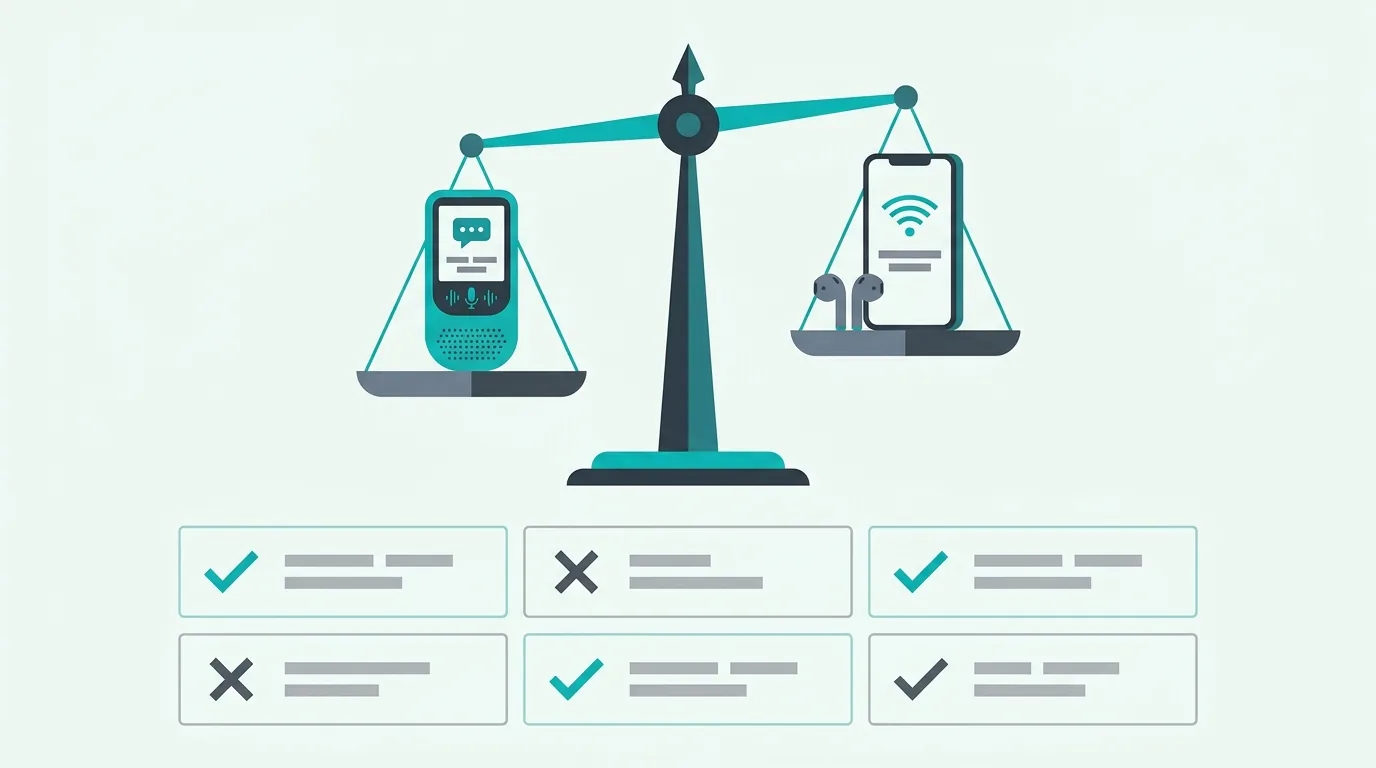
Pocketalk is worth it for a narrow group and not for most individual travellers. A dedicated handheld with a prepaid data plan makes sense when the device is shared, when the person using it will not hand over a personal phone, or when you want translation to work without touching your own data plan. It is a hard sell if you already carry a smartphone and need translation for a trip or two a year, because a free phone app covers menus, signs and short exchanges. On Pocketalk's own site on 11 November 2026 the S2 is $199 or $249 and the S2 Plus is $269 or $349, depending on whether you take the 2-year or 5-year data plan. The verdict grid below gives a yes, no or depends for six buyer types.
I sell a competing product, a $69 earbud kit with an optional $39-a-year translation app, so weigh that. Every Pocketalk figure below was read from Pocketalk's own pages on 11 November 2026, and I name the source each time. Where a page did not state a number, I say so.
What does Pocketalk actually include in the box?
Pocketalk sells several things now, but the consumer line is two handhelds: the S2 and the larger S2 Plus. Pocketalk's device page lists them side by side:
| Pocketalk S2 | Pocketalk S2 Plus | |
|---|---|---|
| Screen | 2.7 inch | 3.9 inch |
| Price, 2-year eSIM plan | $199 | $269 |
| Price, 5-year eSIM plan | $249 | $349 |
| Languages | "92+" | "92+" |
| Data coverage | "over 170 countries and regions" | "over 170 countries and regions" |
| Standby battery, as published | up to 179 hours | up to 213 hours |
Two details are easy to miss. First, the price you see depends on the data plan you pick, so confirm which variant is in your cart. Second, the standby number is standby, not translating time. Pocketalk's page describes it as continuous standby, which tells you how long the device idles, not how many conversations you get from a charge.
The S2 starter bundle page lists the device, a clear protective case and a screen protector. On the S2 Plus product page I read, the box contents were the device, a user manual and a USB Type-C charging cable. The language figure breaks down on that page as 61 bilateral voice languages, 21 bilateral voice-to-text languages and up to 37 more with one-way voice-to-text, plus camera recognition for 55 languages. So "92+" is a ceiling, and the number of languages you can hold a spoken two-way conversation in is smaller.
The product runs on an internet connection. Pocketalk's page says it requires Wi-Fi, mobile data or a personal hotspot and cannot be used offline. That is true of nearly every speech translator, mine included, and it matters when you read the grid below.
Who gets real value from a dedicated handheld?
The device earns its price when the problem is not translation quality but ownership and handoff.
A shared device. A school front office, a clinic desk or a hotel counter needs something that sits on a shelf, charges overnight and gets passed across a table. Nobody is asked to hand over a personal phone, and nothing buzzes with a notification mid-sentence. This is where the "dedicated device" argument is strongest, and it is the reason Pocketalk keeps an enterprise line and a business sales contact on its site.
Someone who cannot or will not use a phone for this. An older relative, a visitor with no data plan, a person who does not want to open their phone in front of a stranger. The device has one job and a camera for signs and menus.
A prepaid connection you do not manage. The embedded eSIM covers over 170 countries and regions per Pocketalk's page, so you do not buy a local SIM or hunt for Wi-Fi. For a frequent traveller who dislikes roaming charges, that is a real convenience. The renewal details are in what the Pocketalk data plan really costs, so I will not repeat the ledger here.
Where does a free phone app do the same job?
For one person with a smartphone, most of the time. Google Translate, Apple Translate and similar apps handle typed phrases, a spoken back-and-forth in conversation mode and camera translation of a menu, for $0. Google's help page also explains that you can download languages for offline use when you connect to Wi-Fi first, and that translating text in downloaded languages works with no connection. Pocketalk's page says its device cannot be used offline at all. If your trip has dead zones, the free app wins on that one point, and I walked through the trade in Pocketalk versus Google Translate.
What the phone does not do as well is the awkward part. Holding a phone between two faces breaks eye contact, you may not want to pass a personal device across a counter, and a cracked or low battery phone takes your maps and tickets down with it. Those are genuine advantages for a dedicated device. They are not worth $200 to $350 to someone who needs to ask for the bill twice a year.
What does ownership cost beyond the sticker price?
Three things sit behind the purchase price.
The data plan ends. The 2-year variants are the cheaper entry, and the 5-year variants cost $50 to $80 more. After the term you renew, use Wi-Fi or a hotspot, or put in a SIM. I could not find a renewal price for the S2 series on a Pocketalk page, so I will not guess one.
The warranty is short and excludes the battery. Pocketalk's warranty page states one year from purchase in the standard case and two years for purchases in the EEA. It excludes "consumables (such as batteries)", embedded software, cosmetic damage and any buyer who is not the original purchaser. A battery that wears out after year two is yours to deal with, which matters for a sealed handheld you might keep for five years.
Resale and gifting are limited. Because coverage applies to the original purchaser and excludes resellers, a second-hand unit comes without protection.
Against that, compare the running cost of the alternatives. Our kit is $69, and AI Translation Live is $39 a year if you want it. Renewed every year, that is $264 over five years against $249 to $349 for a 5-year Pocketalk plan. The totals are close; what differs is what you hold. Ours is two earbuds you wear plus a phone you already own. Pocketalk is one handheld with its own connection. If you do not want to rely on your phone for the job, that difference is the deciding fact.
What do recent owners and reviewers say?
The independent record is thinner and older than the marketing suggests, so here is what I could read and when it was written.
| Source | Date | What it covers | The caveat it raises |
|---|---|---|---|
| Pocketalk Trustpilot page | Read 11 Nov 2026 | TrustScore 2.4 from 6 reviews, 83% one-star | The profile is unclaimed and the sample is tiny. Complaints are about battery failure after the warranty, support and one disputed $44 charge |
| HackerNoon review | 31 Oct 2020 | Two weeks in Japan with a review unit | The author called it useful for travel and menus, said speech recognition was not perfect enough for contract details, and noted translation needs a network |
| Wander Onwards | Updated 29 Apr 2024 | Pocketalk Plus | Sponsored. Lists lag, weakness on slang and the need to hold it close to your mouth in busy places |
| Mrs O Around the World | Sept 2022 | Pocketalk Plus and S | Sponsored. Praised translation quality and battery, and mentions only the two-year data card for ongoing cost |
Two patterns stand out. The positive write-ups are mostly sponsored or from review units, and none I read explains what happens after the data plan ends or how long the battery lasts after the warranty. The negative evidence is a handful of Trustpilot posts, which cannot tell you how common a battery failure is. I would not conclude the product is poor on six reviews. I would conclude that nobody has published a long-term durability test, so you are taking the post-warranty risk on trust.
So is Pocketalk worth it? A verdict for six buyers
This is the grid I would use if you asked me across a table. Each row has one deciding fact.
| Buyer | Verdict | The deciding fact |
|---|---|---|
| Solo traveller with a smartphone | Depends | If you need offline use or hate roaming, the eSIM helps. If not, a free app already does the job |
| Family on one trip | No | Each adult already has a phone, and a free app on each one costs nothing |
| School front desk | Yes | A shared device that nobody has to log into, with bulk ordering available through Pocketalk sales |
| Care-home staff | Depends | The shared, hands-off design fits, but confirm privacy and compliance requirements with Pocketalk's sales team before you rely on it |
| Expat in daily use | Depends | Five years of prepaid connectivity favours the 5-year plan, but daily use also means you will hit the battery and warranty limits first |
| Occasional tourist | No | Two trips a year do not repay $199 or more over free apps with downloaded languages |
The consistent thread is that the device wins on ownership, not on translation. The words it produces come from cloud engines, the same family of technology your phone can reach. You are paying for the shell around it: a screen that is not your phone, a data connection you do not manage, and a single-purpose tool.
What should you buy instead if the answer is no?
Start free. Install a translation app, download your languages while you are on Wi-Fi, and test one real exchange before you pay anyone. If you find yourself holding the phone between two faces, the next step up is audio in your ear, which is the case for earbuds. I compare the handheld, earbud and app routes in Pocketalk alternatives, including where each one loses.
If you want to hear what a browser translation round trip sounds like before you decide on anything, the live demo on the home page lets you speak once and hear it come back translated. Our $69 kit is an option for people who want hands-free audio and are happy to keep using their own phone. It is not a replacement for a shared desk device, and I would not claim it is.
FAQ
Is Pocketalk worth the money?
For schools, offices and anyone who needs a shared, phone-free device, it can be. For one traveller with a smartphone, usually not. The S2 is $199 or $249 and the S2 Plus is $269 or $349 on Pocketalk's site as of 11 November 2026, and a free app covers most casual uses.
Is Pocketalk better than a translation app?
It is better at being a separate device with its own connection, and a free app is better on cost and offline use. Pocketalk states the device cannot be used offline, while Google lets you download languages for offline text translation. Neither is better at translation in a way I can measure from published sources.
How long does a Pocketalk last?
Pocketalk does not publish a lifespan. What it does publish is a one-year warranty (two years in the EEA) that excludes batteries, and a data plan of 2 or 5 years depending on the variant. The physical unit may outlast both, but I found no independent long-term durability test.
Does Pocketalk work in every country?
No. The embedded eSIM covers "over 170 countries and regions" per Pocketalk's device page, which is not every country. Outside coverage you can use Wi-Fi or a hotspot, because the device needs an internet connection either way. Check the coverage list on Pocketalk's site for your destination before you buy.