AI Translation vs a Human Interpreter: When to Pay
By Mark Fulton · September 11, 2026
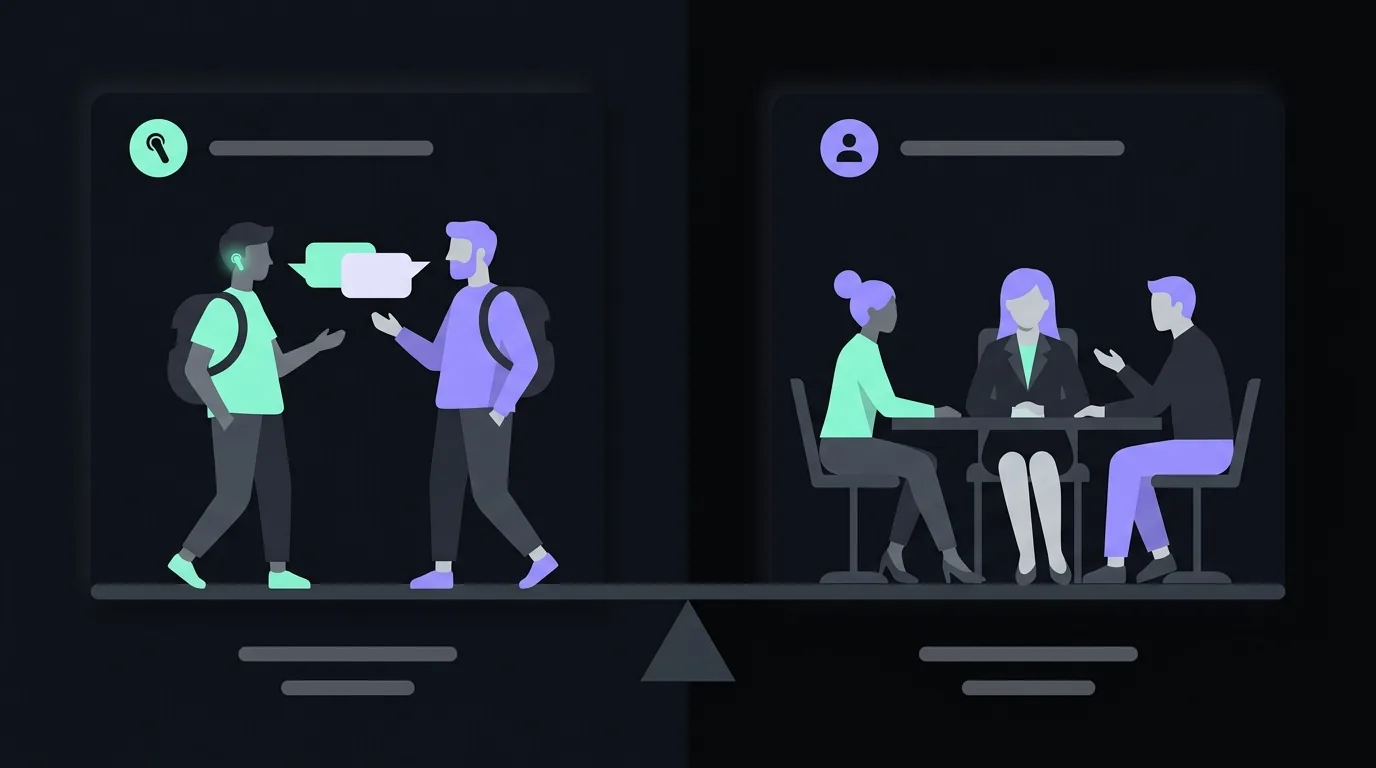
Use AI translation when a misunderstanding costs you a repeated sentence, and pay a human interpreter when a misunderstanding costs you a diagnosis, a contract, a case, or someone's safety. That is the whole rule, and almost every argument you will read about this topic is an attempt to move the line in the direction the author gets paid. A machine is faster to start, available at any hour, and cheaper by two orders of magnitude. A person handles crosstalk, repairs a confusion before you notice it, carries register and culture rather than words, and has professional standing in a formal record. Those are not competing products. They are different tools that happen to share a verb.
I sell the machine. AIEarbuds sells a translation earbud kit and a browser speech translation app, so my financial position on this question is not subtle, and you should read everything below with that in mind. The reason I am writing it anyway is that the two loudest voices in this argument are an industry association defending its members and a set of software vendors selling replacement. Both are arguing a position. I would rather publish the line as I actually understand it, including the large territory on the other side of it, than pretend my product reaches further than it does.
Which side wins on each axis?
Six things people actually mean when they ask this question, with the winner named rather than hedged.
| What you are comparing | AI translation | A human interpreter | Honest winner |
|---|---|---|---|
| Cost per hour | Single-digit dollars, often less | Hundreds of dollars per day, with minimums | AI, and it is not close |
| Latency inside a turn | Usually waits for you to finish a thought before it speaks | A simultaneous interpreter begins rendering while you are still talking | Human |
| Two people talking over each other | The weakest case in the whole category. Recognition has to decide where one voice ends before anything can be translated | Handles it, and will stop the room when it cannot | Human |
| Cultural mediation | Translates what was said. Does not tell you that what was said will land badly | Reframes, softens, flags the thing you did not know you were doing | Human |
| Standing in a formal or legal record | No professional accountable for the rendering | Named, credentialed, sworn where required, and answerable for accuracy | Human |
| Available at 2am, in a taxi, with nobody booked | Yes, immediately, in a browser | Telephone interpreting exists and is good, but it is a call you have to place and pay for | AI |
Four rows to the person, two to the machine. If you were expecting the vendor selling the machine to score that differently, that is exactly the problem with most of the writing on this subject.
What does a human interpreter do that a model doesn't?
The job is not word substitution. Watch a good interpreter work and most of what they do is not visible in the output at all.
They manage the conversation. They will stop a speaker who is running too long, ask for a repeat, tell the room that a term has no equivalent and here is the closest thing, and they will do it out loud so everyone knows a repair happened. A model produces a fluent sentence and never signals uncertainty. That asymmetry is the single most dangerous thing about machine output: the confidence of the delivery is unrelated to the accuracy of the content. A dropped negation sounds exactly as smooth as a correct sentence.
They carry register. The same sentence said to a customs officer, a client and a mother-in-law needs three different renderings, and choosing between them is a judgement about the relationship, not about the language. Models are improving here and are already decent at formality selection when you tell them the context. They are not making relationship judgements you did not ask for.
They mediate rather than transmit. An interpreter notices that your directness is reading as rudeness and quietly adjusts. They notice that the other person said yes while meaning no. They tell you afterwards. That is the part of the work that the association writing op-eds about AI is genuinely right about, and I have never seen a machine do it.
They are accountable. A credentialed interpreter has a professional body, a code of conduct, and a name attached to the rendering. If the meaning was wrong, there is a person to ask. When a model gets it wrong, there is a log file.
A 2026 review in PLOS Digital Health on AI-mediated health interpretation put the state of the evidence plainly: AI translation performs best on short, structured written content, while real-time spoken interpretation presents greater challenges, and current systems often miss idiomatic language, emotional nuance, and contextual cues. The same review noted that in a study of pediatric discharge instructions, machine translation was non-inferior to human translation for Spanish but produced more errors and lower fluency in Chinese, Vietnamese and Somali. That pattern matters more than any single accuracy figure: the quality gap is not uniform, it opens up in exactly the languages where a patient or a customer is least likely to have an alternative.
Where does the machine genuinely win?
Not on quality. On the conversations that were never going to have an interpreter in them.
Nobody books a professional for a taxi ride, a pharmacy counter, a market stall, a hotel check-in, a conversation with a neighbour, or a Tuesday chat with the person who cleans the building. Those conversations currently happen through pointing, guessing, a bilingual colleague who did not sign up for it, or not at all. That is the market the machine is actually in. It is not taking work away from a court interpreter. It is filling a space where the alternative was silence.
The machine also wins on three practical properties that have nothing to do with translation quality:
It is there before you knew you needed it. No booking, no minimum, no scheduling. The moment somebody speaks, it works.
It is repeatable at zero marginal effort. Ask the same question five times in five different phrasings until it lands, and nobody gets tired or charges you for the extra half hour.
It does not add a third person to the conversation. For a private or slightly embarrassing exchange, that matters. Some people say things to a machine that they will not say in front of an interpreter, and that is a real clinical and personal finding, not a marketing line.
And a limit on my own side, stated plainly: the machine is at its worst precisely where the stakes are highest. High-stakes conversations tend to be emotional, fast, overlapping and full of specialised terminology, which is the exact combination that degrades machine output the most. Our kit is not the answer for those, and I have written the same thing on where translation earbuds belong in a business meeting and on hospitals and caregiving.
What does each option cost per hour?
Real published numbers on both sides, because most comparisons on this topic give none.
On the human side, the US federal judiciary publishes its contract court interpreter rates, which makes it one of the few genuinely citable price lists in the industry. For the current fiscal year, a federally certified interpreter is paid $566 for a full day, $320 for a half day, and $80 per hour of overtime. A professionally qualified interpreter is $495 full day and $280 half day. A language-skilled, non-certified interpreter is $350 full day and $190 half day. Those rates rise on October 1, 2026, to $617, $540 and $382 for a full day respectively. Private-sector conference and medical rates are set by the market and vary widely, but the shape is the same: you are buying a half day at minimum, not fifteen minutes.
On my side, the arithmetic is public because I have to publish it anyway. The earbud kit is $69 once. AI Translation Live is $39 a year and includes 5 hours of live speech translation, which works out to $7.80 per hour across that allowance. If you run out, five more hours is $19, which is $3.80 an hour.
So the honest comparison is roughly $3.80 to $7.80 an hour against a $320 half-day minimum. That is not a close contest, and it is also not a meaningful one, because the two things are not substitutes at any price. The right way to read those numbers is not "the machine is 40 times cheaper". It is "the machine makes a category of conversation affordable that was previously not worth the transaction cost of arranging anything at all". Nobody was going to spend $320 on a pharmacy visit. The correct comparison for that visit is not an interpreter. It is pointing at a box.
Which situations legally require a person?
Rules, not advice. Check with someone qualified in your jurisdiction before you rely on any of this.
In US federal court, the Court Interpreters Act, 28 U.S.C. §1827, is the statute that governs interpretation in proceedings instituted by the United States, and the Administrative Office of the US Courts classifies interpreters into the three categories priced above. The structure of that regime is worth noticing: the rules name people, assign them to graded categories, and pay them by the day. There is no category for a software rendering.
Under the Americans with Disabilities Act, the Department of Justice's guidance on effective communication defines a qualified interpreter as someone able to interpret effectively, accurately and impartially, both receptively and expressively, using any necessary specialised vocabulary. The guidance also sets out that state and local government entities must give primary consideration to the aid or service the person with a disability asks for, and that video remote interpreting is only acceptable when it meets specific performance conditions including a clear, high-speed video connection and staff trained to set it up. In other words, even a remote human over video has published conditions attached before it counts.
Healthcare has its own federal language-access requirements for covered programs, and they restrict leaning on family members or untrained staff. I went through those in detail in the hospitals and caregivers piece, so I will not repeat them here beyond the summary: if it is a clinical encounter, ask for the qualified interpreter rather than reaching for a device.
The practical test that has never failed me: if the conversation produces something that could be read back to you later, by a judge, a regulator, an insurer or a lawyer, you want a person and a record. If it produces nothing but the next sentence, the machine is fine.
How do professionals use AI tools themselves?
Quietly, and more than the public debate suggests. Interpreters use speech recognition for terminology prep, machine translation for glossaries and background documents, and automated transcription for the written record afterwards. Booth partners have always fed each other numbers and names on paper, and software does that job well. The pattern across the profession is augmentation rather than replacement, which is also the conclusion the PLOS review reached from the clinical side.
The professional association for US translators and interpreters has publicly opposed legislative proposals that would allow AI systems to stand in for court interpreters. They have a direct financial interest in that outcome. So do I, in the opposite direction. On this particular question I think they are right, and you should discount both of our opinions and look at the cost table instead: an institution that replaces a certified court interpreter with a subscription is saving a few hundred dollars against the cost of a mistrial. That arithmetic does not work, and no improvement in the model changes it, because the argument is about accountability rather than accuracy.
How should you combine the two?
Sort your conversations into three tiers before you buy anything.
Tier one, machine alone. Transactional, low consequence, repeatable, one speaker at a time. Directions, ordering, shopping, small talk, check-ins, routine coordination. Use the machine and do not feel bad about it.
Tier two, machine plus a written record. Commercial discussion, scheduling, anything with numbers or dates in it, early-stage negotiation. Use the machine for the live conversation, then send a written summary in both languages and ask for confirmation. The written layer catches the fluent-sounding error that nobody in the room could hear.
Tier three, book a person. Legal proceedings, clinical encounters, safety instructions, employment matters, anything binding, anything emotional, anything where several people will be talking at once. Book a qualified interpreter, and if it is remote, check the connection and the setup before the conversation starts rather than during it.
Two habits make tiers one and two dramatically more reliable, and they cost nothing. Fix the language pair instead of relying on auto-detection, which guesses badly on short utterances. And speak in complete short sentences with a pause at the end, because the recognition step is what fails first and it fails on fragments and crosstalk, not on vocabulary.
Frequently asked questions
Will AI replace human interpreters?
Not for the work that has a professional standard attached to it. The rules that govern courts, clinical care and accessibility are built around a named, accountable person, and that is a structural feature rather than a technical gap that a better model closes. What AI is already doing is absorbing the low-risk, high-volume conversations that were never interpreted in the first place, and taking over preparation and transcription tasks that used to sit around the work. If you are choosing a career, the honest read is that demand is shifting toward the high-stakes end rather than disappearing.
How much does a human interpreter cost?
For a genuinely citable figure, the US federal judiciary's published contract rates for the current fiscal year are $566 a full day and $320 a half day for a federally certified interpreter, $495 and $280 for a professionally qualified interpreter, and $350 and $190 for a language-skilled interpreter, with overtime billed hourly on top. Those rates increase on October 1, 2026. Private conference, medical and community interpreting is priced by the market and varies by language, region and notice period, but the important structural point is the minimum: you are almost always buying a half day, and rare language pairs cost more because fewer people can do the work.
Is AI translation admissible in legal settings?
That is a question for a lawyer in the relevant jurisdiction, and the answer depends on the forum and on what is being offered. What can be said as a matter of published rule is that the federal court interpreting regime is built around interpreters classified and paid as individuals under the Court Interpreters Act, and that the ADA's effective communication guidance defines a qualified interpreter in terms of a person's ability to interpret accurately and impartially. Neither framework contains a category for unattended machine output. Treat anything a device produced as a working aid, not as the record.
Can AI handle idioms and humour?
Idioms, often, because common ones are well represented in training data and a good model will produce the equivalent expression rather than the literal words. Humour, much less reliably, because most jokes depend on shared context, timing and a shared assumption about what is unsaid. Irony is the hardest case and it fails silently: a model will render a sarcastic sentence as a sincere one with no signal that anything was lost. A human interpreter in that moment does something a machine does not, which is to tell the room that a joke was made and it does not travel.
If your conversation is in tier three, book someone. For everything in tier one, the live demo on the home page runs in your browser, costs nothing, and takes about fifteen seconds. Speak one sentence, hear it come back, and judge where the line sits for yourself rather than taking my word or anyone else's for it.